
Try it!

Identify the degree and function type of the following equations.
| Equation | Degree | Function Type |
|---|---|---|
| 1 | Linear | |
| 2 | Quadratic | |
| 1 | Linear | |
| 2 | Quadratic |
Thinking about degrees of relation in real life
Last learning activity, you looked at graphs of relations to determine if they were linear, quadratic, or neither.

Factoring expressions
Quadratic expressions can be represented in both expanded and factored form. In the last learning activity you expanded expressions from factored form to expanded form.
The opposite of expanding is factoring. In this learning activity, you will learn how to factor expressions.
A factor is a number that is multiplied by another number to give a specific product. In other words, a factor divides evenly into a product. When a number is factored, it is represented as a product of two or more factors.
- For instance, if you want to build a shed so that the area of the floor is , you can choose from a variety of possible dimensions. A shed could be , or or or These dimensions represent factors of .
Using a real life example to explain factoring
Think

You want to build an enclosure for your dog. It will have an area of . What dimensions would require the least amount of fencing (think about which dimensions would give the smallest perimeter)?
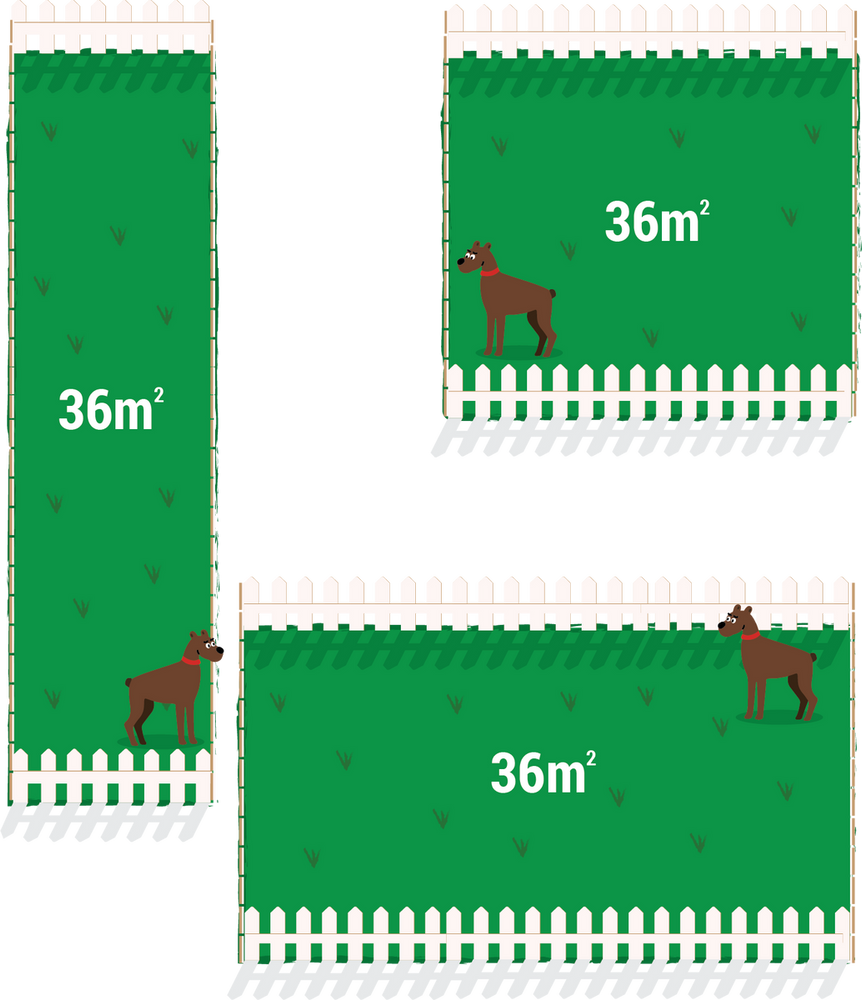
by would require the least amount of fencing.
Possible dimensions are:
- by (perimeter )
- by (perimeter )
- by (perimeter )
- by (perimeter )
- by (perimeter )
How to factor using 5 methods
Over the next three learning activities you will learn how to factor using 5 different methods:

- Factoring out the greatest common factor
- Difference of squares factoring
- Perfect square trinomial factoring
- Factoring simple trinomials
- Factoring complex trinomials
Why are we learning how to factor?
In this learning activity we are going to focus on the first method, factoring using the greatest common factor.
We want to learn how to solve problems involving quadratic relations and factoring is often the first step.

The greatest common factor (GCF)
Factoring type 1
We should always identify a common factor before attempting any other type of factoring. You can factor out any common factor in an expression or equation. Usually it is best to factor out the GCF.
A factor is a number that evenly divides into another. For instance has factors:
- 1 and
- and 3
Using the example: factor
Step 1: Determine the GCF
The GCF has two parts
- The greatest common numerical factor that divides evenly into all terms.
- The greatest variable factor that divides evenly into all terms (the variable needs to be in all terms).
because:
3 is the largest number that divides evenly into 6, 12, and 3.
is the largest variable factor that divided evenly into all terms.
is not part of the GCF because it is not in all terms.
Step 2: Divide all terms by the GCF
Make sure to write the GCF in front and bracket the remaining divided terms.
Notice that we are dividing each term by the GCF.
when you divide powers with the same bases, always subtract the exponents. Examine the steps for dividing the first term by the GCF:
Another approach for finding the GCF
Here's another way to aproach factoring out the GCF:
Let's say you want to find the GCF of .
Imagine each term represented as the product of its factors.
Here is how you would circle all the factors that are the same in each row.
In this case they are , and .
The GCF is .
The factors of each term that are not part of the GCF will form the terms inside the brackets when you divide out .
=

Expanding and factoring
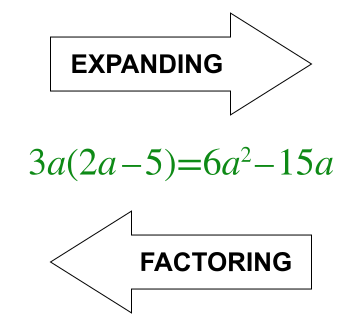
Expanding and factoring are inverse processes.
Expanding: the process of multiplying factors to state an expression in simplified form.
Factoring: the process of representing an algebraic expression in terms of its factors.
It is important you notice that not all expressions can be factored.
Think about this:
Going from left to right, you are expanding; using the distributive property, the term is multiplied through the other factor .
Going from right to left, you are factoring; the expression can be represented as the multiplication of two factors.
Self-check
As a self-directed learner, you will be reflecting on your learning process and checking your understanding in order plan for success. Make a note of your understanding of the success criteria from today’s activity.
Rate your understanding on a scale of five to one.
Five means “I have a thorough understanding.” One means “I am confused.”
Are you able to
Portfolio

Math journal
At the end of the course, you will fine-tune 8 entries (two from each unit) from your math journal and submit them as your “Culminating Assessment - Math Journal” (Opens in new window).
Add this type of factoring into your math journal along with the situations when you use it. Your summary may look like the following:
Factoring out the GCF
|
Explanation of steps |
Example |
Situation when you would use it |
|---|---|---|
Once you feel you are able to fulfill the success criteria, complete the following examples and confirm your solutions with the suggested answers.
Further practice factoring using the GCF
Portfolio
Example 1
Factor the following expressions by dividing out the common factor. When you're finished, submit your answers for feedback.
1. Identify the GCF for each polynomial.
a)
b)
2. Identify the GCF of each polynomial.
a)
b)
3. Identify the GCF for each polynomial.
a)
b)
c)
Submit your portfolio item(s) by pressing the “Go To Portfolio” button.
 (opens in a new window)
Making connections
Example 2
Think
Dividing out a common factor is one way we can factor expressions. Think about your understanding of this type of factoring. When would you use it? How you would describe your steps to a friend who has not learned this concept yet? Do you find dividing out the GCF straightforward or is it challenging? Why?
Submit your explanation and steps to your portfolio for feedback.
Factoring is a powerful tool for revealing important features of mathematical relations, like the vertex of a parabola. Factoring also can be used to make an algebraic equation easier to solve. Factoring out the GCF usually makes other types of factoring more straightforward because the terms inside the brackets will have smaller coefficients and less complicated variables.
If you don’t notice that there is a GCF in an expression until after carrying out other types of factoring you can divide it out then.
Notebook

Use your notebook to work through the following examples:
Divide out the GCF from each bracket and then multiply the GCFs to make the expression as simple as possible.
For example, you may be left with a factored form like this:
Extension activity
Expand and simplify .
Can you think of a way to common factor the above equation that would result in the same answer? Note that some factors may have more than one term!
The GCF is . After dividing out the GCF we are left with 4 and -3
For this one, you have to factor out the binomial . Always put the divided terms in brackets.
Using distributive properties review
Quadratic expressions can be expanded by using the distributive property and then simplified by collecting like terms.
For the product of a monomial and a binomial, the distributive property states that:
For the product of a binomial and a binomial, apply the distributive property states that twice:
Like terms have the same variables with the same exponents.
Three special multiplication patterns are:
One way to factor a polynomial is to examine the GCF of its terms as one of its factors. For example, can be factored as , since is the GCF of each term.