
In this learning activity, you will learn about factoring simple and complex trinomials. Before we discuss these factoring methods, we need to understand what happens when we expand these expressions.
Review how to expand and simplify binomials
In the first learning activity, you learned how to expand and simplify binomials. Let’s review this and inquire about how we could go from that expanded/simplified form back to factored form.
Example 1
Expand and simplify the following:
Example 2
Expand and simplify the following:
Now think of a pattern that would explain how to go from expanded form to factored form.
In the first example, how can we use the 2 and 6 to get the 8 (the middle term)?
Add the numbers to get the middle term.
In the second example, how can we use the 3 and 8 to get the 11 (middle term) and the 24 (end term)?
Multiply the numbers to get the end term.
Add the 3 and the 8 to get the middle term.


Factoring simple trinomials
Factoring type 4
A simple trinomial is in the form
As you discovered in the Minds On section, to find the terms in expanded form you simply multiply the terms in factored form to get the last term, and add them to get the middle term.
The same concept can be applied going backwards to determine factored form from expanded form.
The way we factor simple trinomials is to use the sum and product method also called the trial and error method.
Explore this!

Let us now explore the steps to solve simple trinomials in the following video.
Let us now practice using the sum and product method to factor the following trinomial.
Step 1: Use numbers that multiply to the end term ‘c’ and add to get the middle term coefficient ‘b’
Find two numbers that multiply to 12 and add to 13.
The numbers are 12 and 1.
and
Since the order doesn’t matter another answer is:
Notebook

Use your notebook to complete the following questions, then compare your work with the suggested answers.
Work through a question factoring a simple trinomial using the example: factor
Step 1: Factor out the greatest common factor if necessary and determine the appropriate method of factoring.
Is it possible to factor out a common factor in the example? Why or why not?
No, it is not. There are no numbers or variables that would divide evenly into all terms.
What type of trinomial is this expression? How do you know?
This expression is a simple trinomial because a = 1 (the coefficient in front of is one).
What type of factoring should we be using?
Sum and product factoring (also called trial and error factoring) should be used.
Step 2: Determine two numbers that multiply to ‘c’ and add to ‘b’
Remember quadratics in expanded form are
What are we adding to? What are we multiplying to?
Adding to 6 and multiplying to -16.
What two numbers satisfy the conditions? Always use the proper signs.
- 2 and 8 add to 6 and multiply to -16.
- 2 + 8 = 6
(-2)(8) = -16
Step 3: Indicate the numbers from Step 2 in binomials with the appropriate variables.
In this situation we would sub the numbers in but remember the variables may not always be x.
OR
The order of the binomials do not matter, they would both expand and simplify to .

Factoring complex trinomials
Factoring type 5
A complex trinomial is in the form
Explore this!
Let’s explore the detailed steps involved in factorizing quadratics in the following video.
Notice that we cannot use sum and product factoring for complex trinomials because the coefficient of the squared term is not one.
To develop a method for factoring, let’s examine products of binomials that give this type of trinomial.
|
Binomial product |
Expanded form |
Simplified form |
|---|---|---|
|
Product: |
||
|
Sum: |
Observe that in the expanded form, the coefficients of the middle terms, and , have a sum of .
Also, observe that the coefficient of the term, , and the constant term, , have a product of .
Decomposition method for complex trinomials
We will use the decomposition method pattern (hinted at above) to factor
Find two numbers whose sum is -13 and whose product is -30.
The two numbers are –15 and 2.
The middle term can be represented as .
The trinomial would become:
.
Find the common factor of the first two terms and the common factor for the last two terms.
The first two terms are . The common factor is .
The last two terms are . The common factor is 1.
Link the factored pairs of terms with addition or subtraction. You will always use the sign of the third term to help you decide which operation to use. In this case, addition is chosen because the third term is .
Notice that in this case, we show the ‘1’ for the common factor of the last two terms.
At this step, the brackets should match. If they are different check your work to find the mistake.
This method of factoring is called the decomposition method because you decompose (break down) the middle term into the sum of two terms.
Notebook
Use your notebook to complete the following questions, then compare your work with the suggested answers.
Example
Work through a question factoring a complex trinomial using the example: factor
Step 1: Factor out the greatest common factor if necessary and determine the appropriate method of factoring
Is it possible to factor out a common factor in the example? Why or why not?
No, it is not. There are no numbers or variables that would divide evenly into all terms.
What type of trinomial is this expression? How do you know?
A complex trinomial because a 1 (the coefficient in front of is 3)
What type of factoring should we be using?
Decomposition.
Step 2: Determine two numbers that multiply to ‘ac’ and add to ‘b’
Note that is the standard form of a quadratic expression.
What are we adding to? What are we multiplying to?
Adding to 7
Multiplying to because
What two numbers satisfy the conditions? Use the proper signs in your answer.
and add to and multiply to -18
Step 3: Decompose the middle term using the numbers from Step 2
OR
The order when decomposing the middle term does not matter. I will show both options so you can self-check your work.
Step 4: Factor out the greatest common factor of the first two terms and the last two terms
OR
Notice how, when is the third term, a common factor of -3 is factored out of the last two terms. Also, notice that the two sets of brackets for each side are the same
Step 5: Factor out the common binomial factor.
Refer back to learning activity 2 in the ‘extension’ section to see a full explanation of factoring out a common binomial factor.
OR
Notice that the two answers are the same as the order of the binomials does not matter
Trial and error method for complex trinomials
You have just learned the decomposition method to factoring complex trinomials.
Another method is the trial and error method for complex trinomials. At first, this method will take more time than the other methods, but your speed will increase with practice. You can choose either method to factor complex trinomials. It is based on personal preference.
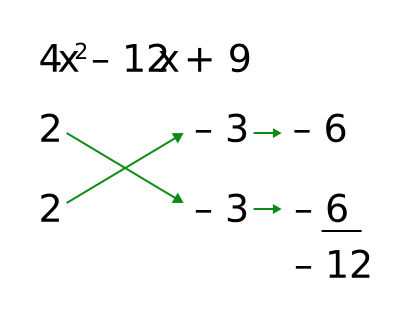
Let’s apply this trial-and-error method to:
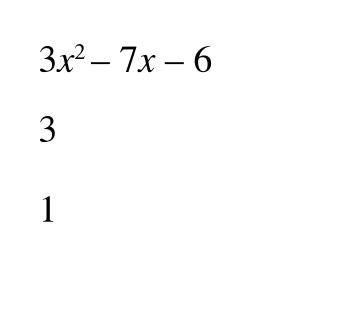
Step 1:
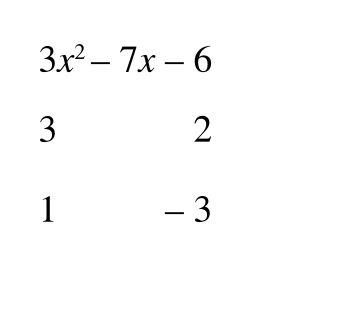
Find 2 factors of 3, say 3 and 1. Represent, as shown, below the 3:
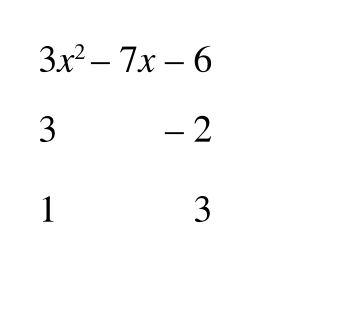
Step 2:
Find two factors of –6, say –2 and 3. Represent these below the –6:
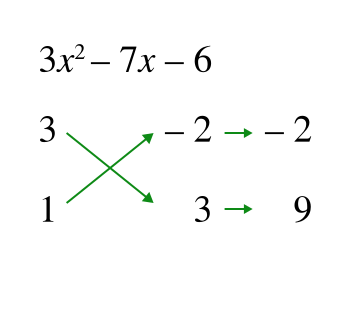
Step 3:
Multiply the numbers on the diagonal: and
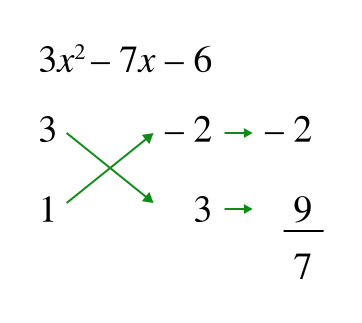
Step 5:
Compare this sum with the coefficient of the middle term –7.
Since 7 ≠ –7, we will switch the signs for the factors of –6.
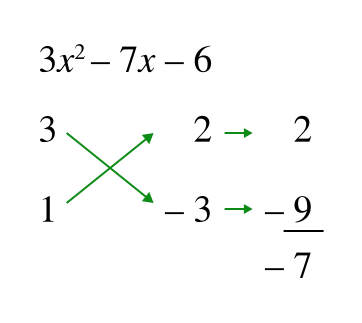
Let’s use 2 and –3:
Step 6:
Multiply the new numbers on the diagonal: and .
Add these together: .
Step 7:
This sum is equal to the coefficient of the middle term –7.
Now use the numbers 3 and 2 to represent the binomial . The numbers 1 and –3 will make up the second binomial . Notice that the 3 and 1 each have an x so that their product is , which is the first term of the trinomial. Therefore, the answer is .
You can check your work by seeing that the product of these two binomials results in the original trinomial, as follows:
Explore this!
For a summary of the trial-and-error method covered here, explore the following video.
Notebook
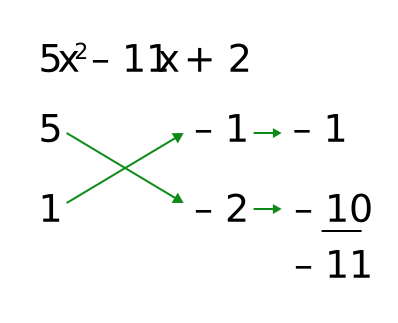
Now, in your notebook, apply the trial-and-error method to factor the trinomial
When you’re finished, compare your solution to the suggested one.

Terminology
- General equation for a trinomial quadratic is .
- A simple trinomial is when
(e.g., → simple trinomial whereas → NOT a simple trinomial).
Factoring simple trinomials
- Use the sum/product rule → find 2 numbers whose product is and whose sum is .
- Some helpful tricks:
- Start with the product of two numbers and then find their sum
- Use the signs of and to help you determine the signs of the factors.
- Use the size (magnitude) of to help you determine how far the factors are from each other.
- You can VERIFY your answer by expanding to see if you arrive at the original question.
Factoring complex trinomials
For a complex trinomial, first make sure no common factor exists (not a simple trinomial in disguise like: ) →Identify… common factor first (if possible).
Factoring by decomposition
- Given a trinomial , find two numbers whose product is and whose sum is .
- Break apart the middle term as a sum of the two factors from step 1.
- Common factor the first two terms and the last two terms separately.
- Common factor the expression that is found in step 3.
- Verify your solution by expanding.
Self-check
As a self-directed learner, you will be reflecting on your learning process and checking your understanding in order plan for success. Make a note of your understanding of the success criteria from today’s activity.
Rate your understanding on a scale of five to one.
Five means “I have a thorough understanding.” One means “I am confused.”
Are you able to
Portfolio

Math journal
At the end of the course, you will fine-tune 8 entries (two from each unit) from your math journal and submit them as your “Culminating Assessment - Math Journal.” (Opens in new window)
You have learned different methods of factoring. You were also shown that there can be more than one method option to solve some questions. There may be one correct final answer for factoring, but the process may look different for each person!
In this activity you learned how to factor simple trinomials using the sum and product method (or trial and error for simple trinomials). Think about when you can use it, the steps you take to complete it, how easy you find it and why.
Add these types of factoring into your math journal along with the situations when you use it. Your summary may resemble this:
Sum and product
|
Explanation of steps |
Example |
Situation when you would use it |
|---|---|---|
You also learned two different methods for factoring complex trinomials.
Decomposition
|
Explanation of steps |
Example |
Situation when you would use it |
|---|---|---|
Trial and error for complex trinomials
|
Explanation of steps |
Example |
Situation when you would use it |
|---|---|---|
Further practice factoring trinomials
Once you are comfortable with the success criteria, try some questions to assess your progress with the material.
You must always:
Check for a common factor first!
Portfolio
Examples
Factor the following four trinomials using the factoring method of your choice.
1)
2)
3)
4)
Submit your answers to your portfolio for feedback.
Submit your portfolio item(s) by pressing the “Go To Portfolio” button.
 (opens in a new window)
Making connections:
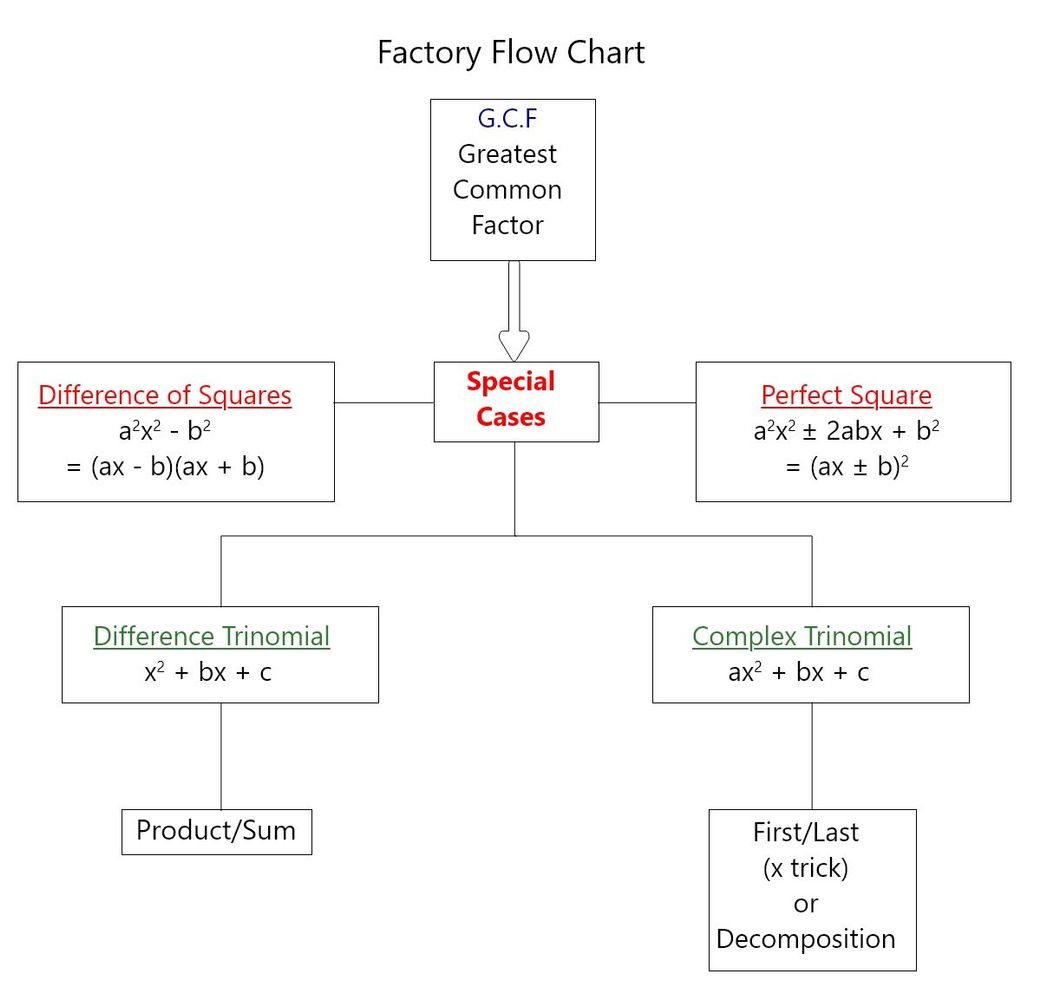
We have learned four different types of factoring during this and the last learning activity:
- Factoring using difference of squares.
- Factoring perfect square trinomials.
- Factoring using sum and product for simple trinomials.
- Factoring using decomposition or trial-and-error for complex trinomials.
You have learned when to use each type of factoring and have added this to your math journal.
Do you think it is possible to use more than one type of factoring?
Let’s explore this.
Expression 1
Given the expression what type of factoring should you use and why?
Difference of squares because it satisfies:
- two terms
- difference between terms
- Perfect square terms
Factor
Can you factor the above expression using a different type of factoring? Identify the type and factor using that method. (Hint: you could say this is a trinomial with a b value of 0)
Sum and product for simple trinomials because a = 1.
Two numbers that multiply to -9 and add to 0 would be + 3 and – 3.
.
Which method of factoring did you find easiest? Why?
This is a matter of opinion, but you may have liked differences of squares better because you do not have to determine two numbers that multiply and add to certain numbers.
Expression 2
Given the expression what type of factoring should you use and why?
Perfect square trinomials because it satisfies:
- First and last term are perfect squares.
2 = b
Factor
Can you factor the above expression using a different type of factoring? Identify the type and factor using that method. (Hint: notice the a value of the trinomial is not 1)
Decomposition or trial and error for complex trinomials
Decomposition:
Which method of factoring did you find easiest? Why?
This is a matter of opinion, but you may have liked perfect square trinomial factoring better because there were less steps and less calculations involved.
In the last exercise you learned that you may be able to factor using more than one method, but you will often find one method quicker and /or easier.