
The aim of this learning activity is to use different factoring strategies to solve quadratic equations. As you have learned so far, solving an equation means finding the value of the variable that makes the equation true. Your answer is then referred to as a solution.
Try it!

As a starting point, let us examine how we solve the following linear equation.
Example 1:
Projectile motion
Quadratic equations describe applications of projectile motion and can be used to make predictions like the ones you will make in this activity. Because quadratic equations are second degree, they cannot be solved using the strategies that work for linear equations. In this learning activity you will find out how factoring can help to get the job done!
Explore this!

Explore the following video of an athlete throwing a discus. Take a close look at the path of the discus as it travels in the air. Do you recognize the shape of this pathway? The path of the discus traces the shape of a parabola.
Consider what characteristics of the parabolic path of the discus you can observe as it travels until it hits the ground. Also consider how this pathway could be represented as an equation and how you might use that equation to determine how far the discus traveled.

Review

As you have learned, in order to solve quadratic equations, we first need to know how to solve linear equations. Let’s review how to solve linear equations with more examples.
How can you tell if an equation represents a linear relation?
After expanding and simplifying, the highest degree on a variable is ‘1’. In other words, it is linear if there are no trigonometric functions and if no variable is raised to the power of 2 or higher.
Solving a linear equation review:
Using the example
Step 1: Simplify the equation if necessary.
Note that you should apply the distributive property and multiply the 6 outside the bracket with the x and the -2 in the bracket.
Step 2: Isolate the variable.
Note that you should perform the opposite operation to both sides of the equation to isolate.
Step 3: Simplify the answer if necessary.
Make sure to reduce any fraction to lowest terms in your final answer.
Check your solution.
You can always verify your solution by substituting the value into the original equation to see if the left side (LS) and right side (RS) of the equation are equal. Here is one way to do it.
Therefore the LS = RS, so the solution is correct.
Solving quadratic equations
In the previous learning activities, you learned how to factor quadratic expressions.
Explore this!
In the following video, you will explore how to solve a quadratic equation. The video also explains how the solution can be presented on a graph.
In order to solve quadratic equations in a factored form, it is important to understand the zero-property rule because we want to know under what situation will our equation equal zero.
Zero property rule
if or
or and
This is true because any value multiplied by 0 will make the entire equation 0.
Now let’s see how this applies to quadratics. We will be working with quadratics in factored form. The phrase “factored form” means we have two values (factors) multiplied together.
For the quadratic what value of will make the first bracket equal to 0?
will make the first bracket zero
What value of will make the second bracket equal to 0?
will make the first bracket zero
The equation is true if or if . You can substitute both values back into the equation to confirm that either will make the entire equation equal to 0.
Notebook

In your notebook, solve the following equations. When you’re finished, compare your answers against the suggested ones.
Solving quadratic equations
To solve a quadratic equation, we are solving for the point(s) where the parabola will hit the x-axis. These points are called the -intercepts.
Now let’s explore how to model the trajectory of a horseshoe being tossed.
We will solve some real-life problems involving quadratic equations.
Try it!
Modelling the trajectory of a horseshoe
Consider the following photo of a person competing in a horseshoe toss. The players take turns throwing horseshoes at large metal stakes in the ground. What questions do you have about this picture? Is there anything you want to know?
Will they throw the horseshoe far enough? What are the rules for horseshoes? Do you throw a horseshoe straight like a frisbee? Does it arc?
If you wanted to know if the player would throw a ringer (get the horseshoe around the stake) what information would be helpful?
The distance from the player to the stake is . We don't know the height of the person, the length of their arm, the velocity or arc at which they makes the throw, so here's an equation to work from:
In this exercise, represents the height (m) of the horseshoe and represents the horizontal distance the horseshoe travels (m).

What could you do with the information provided?
You could graph the relation on paper using a table of values or with technology.
Produce a graph of this function by creating a table of values, compare your graph with the suggested answer.
Notebook
In your notebook, work through the following questions and then compare with the suggested answers provided.
Based on your graph and the one provided, did the person throw a ringer?
It is still a bit difficult to tell based on the graph. We need to know where the post is located to throw a ringer. And we would have to know the exact point where the graph hit that x-axis.
What is the y value of a coordinate point on the x-axis?
The y value on the x-axis will be 0. (x, 0) will be the coordinate point. Remember that this point is called an x-intercept.
Quadratic equations in factored form are in the general form , we can determine the x-intercepts (where the parabola touches the x-axis), because the y value is zero. We need to determine when each factor will equal zero.
Recall that the equation for the path of the horseshoe is
What will the height of the horseshoe be when it lands on/near the stake?
The height, or h value, will be zero
What are we trying to solve for in this equation to answer the question, ‘will the horseshoe hit the stake?’
We are trying to solve for the x-value (horizontal distance), when the height, , is 0. These points are the x-intercepts of the parabola.
In order to solve for the x value in this quadratic, we must get it into factored form. What would this equation be in factored form?
Notice that this equation is already common factored.
Using decomposition or trial and error
In the brackets of the original equation, there is a complex trinomial. We must use decomposition or trial and error.
Decomposition:
*determine two numbers that multiply to
and add to
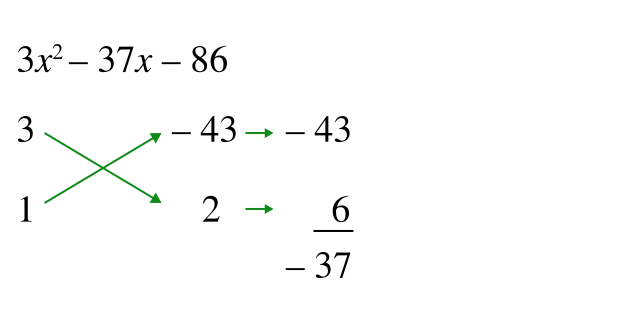
For what value(s) of will the equation equal 0? Simplify any fractions in your answer.
or
Remember that
Examine the x-intercepts to determine when the horseshoe will hit the ground and will it hit the stake?
The horseshoe will hit the ground at approximately 14.3m so it will not hit the stake directly. (Remember that the stake was 14.4m away.)
Notice that we disregard the other value because it does not make logical sense for it to hit the ground at -2m.
The reason why that x value exists is because in theory this parabola has two x-intercepts. The part of the parabola to the left of the starting height only exists in theory and is not considered for this word problem.
Modelling the trajectory of a soccer ball

A team won the World Cup with a score of 4 to 2. Using the example: a soccer ball is kicked from the ground and is modelled by the equation , where is height in meters and is time in seconds. Determine for how long the ball was in the air before it hit the ground after being kicked.
Step 1: Set equation equal to zero:
Sometimes you will have to substitute a value for the independent variable (height in this case) and then solve.
For this problem, we want to determine the time when the ball is on the ground so for the height, we will substitute in 0.
Step 2: Factor the equation.
Remember to use the most appropriate method and to always common factor first.
Common factoring is the only method needed to factor this equation.
Step 3: Solve for the x-intercepts
Notice that in this question, we used the variable t for the horizontal axis, so here we would find the -intercepts.
or
Step 4: For word problems, use the intercepts to answer the question
Sometimes both horizontal intercepts do not make sense (negative time and distance).
Sometimes the question is looking for a specific answer instead of just the intercepts.
It is often helpful to sketch/graph the situation to help answer the question better.
The ball was in the air for 3s.
The ball is on the ground at 0s (this makes sense because the question told us it was kicked from the ground) and does not land again until 3s. From 0s to 3s the ball is in the air, that is 3s in total.
Example:
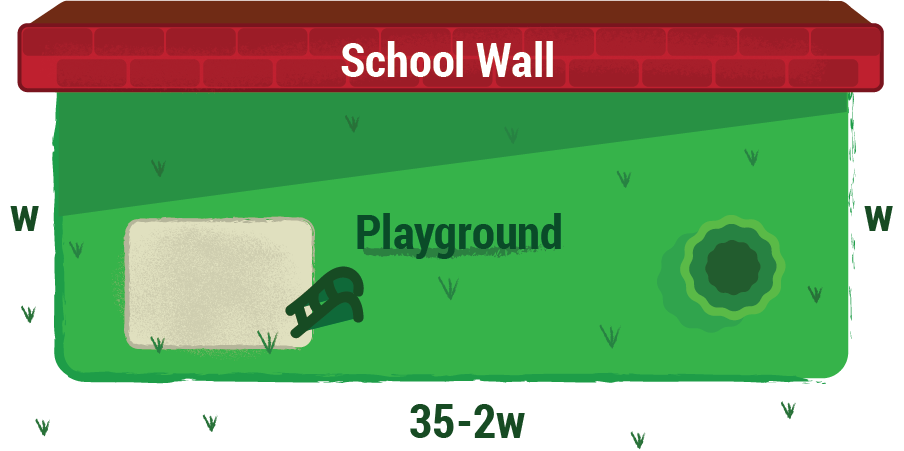
A rectangular play area in a school playground is enclosed on one side by the wall of the school and on the other three sides by 35 m of fencing.
The area, in square metres, of the playground is represented by , where represents the width of the playground in metres. Determine the dimensions of the playground if the area is .
Use the procedural steps to solve this problem.
The area is . Substitute into the equation and rearrange so it equals zero.
You could use decomposition or trial and error for this question.
Either or .
Therefore, or .
Therefore, the width is either 2.5 m or 15 m.
From the diagram, you know that the length of the playground is .
a) When , the length of the playground is:
When the width is 2.5 m the length will be 30 m.
b) When , the length of the playground is:
When the width is 15 m the length is 5 m.
The dimensions of the playground can either be 2.5 m by 30 m or 15 m by 5 m. Both sets of dimensions will produce an area of .

Self-check
As a self-directed learner, you will be reflecting on your learning process and checking your understanding in order plan for success. Make a note of your understanding of the success criteria from today’s activity.
Rate your understanding on a scale of five to one.
Five means “I have a thorough understanding.” One means “I am confused.”
Are you able to
Portfolio

Math journal
At the end of the course, you will fine-tune 8 entries (two from each unit) from your math journal and submit them as your “Culminating Assessment - Math Journal.” (Opens in new window)
In this activity you learned how to solve quadratic problems by factoring. Think about when you can use it, the steps you take to complete it, how easy you find it and why, etc.
Add this method to solve quadratic relations into your math journal along with the situations when you use it. Your summary may resemble this:
Solving by factoring
|
What does it mean to solve a quadratic relation? |
Why must you set the equation to zero in order to solve a quadratic? |
Explanation of steps |
Example |
How do the zeros relate to a graph? Include a graph of your example using a graphing app of your choice. |
When you can use this method |
|---|---|---|---|---|---|
Once you are comfortable with the success criteria, try some questions to assess your progress.
Portfolio
Find the x-intercepts
In your notebook, determine the -intercepts for each of the following equations. When you’re finished, compare your answers with the suggested ones.
1)
2)
3)
4)
5)
6)
It is important to examine how the x-intercept values you determine algebraically relate to the graph of its parabola.
Submit your answers to your portfolio for feedback.
Submit your portfolio item(s) by pressing the “Go To Portfolio” button.
 (opens in a new window)
Question 2

Please note that we are learning to solve quadratic problems so we can apply the same process to real-life examples of quadratic relations.
A football is kicked vertically, with an initial speed of 45 m/s. Its height, metres, at any time, seconds, is given by . Determine how long the ball is in the air.
Either or .
Therefore, or .
Therefore, the ball was in the air for 9 seconds.
Question 3

A rectangular garden is enclosed by 60 m of fencing. The area of the garden is given by , where represents the width of the garden in metres.
Determine the dimensions of the garden if the area is 200 m2.
The equation represents the area of the garden. To find the dimensions when the area is , substitute into the equation and solve for .
Expand the right side.
Move all terms over to the left side.
Find two numbers whose product is and add to .
The numbers are and .
or
or
From the diagram, the length of the garden is .
Determine the length of the garden for each width.
For , the length of the garden is:
length
length
So, the dimensions by will produce a garden with area .
For , the length of the garden is:
length
length
And the dimensions by will also produce a garden with area .
Question 4
Most of the quadratic relations we looked at today cross the -axis twice. Is this true for all parabolas? Are there any other options?
Use graphing software to try to graph a parabola with no -intercepts.
Use graphing software to try to graph a parabola with one -intercept.