
We have already studied the standard form and factored form of the quadratic equation. In this learning activity, you will be introduced to a method to convert standard form of the quadratic equation to the Vertex form of the equation.
The reason for learning this method is that a quadratic function expressed in standard form provides only limited information about the function. The vertex form of the same function, however, provides much more detail. Specifically, the vertex form gives the optimal value (max/min) which is particularly useful when solving problems.
To convert from standard form to vertex form, we will learn a method called completing the square.
Let us learn more about the vertex form of the equation in the following video.
Explore this!

Examine the following video that explains the vertex form of quadratic functions.
In the following steps, we will initiate the process of learning about method to convert from standard form to vertex form.
Think

Earlier in the course, you learned about factoring perfect square trinomials.What makes an expression a perfect square trinomial?
For any expression in standard form
- and must be perfect squares
- must be equal to the double product of the square roots of and
For example: is a perfect square trinomial because and are perfect squares and .
Try it
What value would create a perfect square trinomial?
36
25
100
16
64
81

Converting vertex form to standard form
A quadratic equation is converted from vertex form, , to standard form,, by expanding and simplifying. We reviewed expanding and simplifying binomials earlier in the course, you may want to review that before continuing with this learning activity if necessary.
Now let’s examine an example of when we would convert from vertex form to standard form. Answer the question on your own and then compare with the suggested answers.
A batter is practicing their swing on the flat roof of a building that is 5 m tall. The batter hits a baseball, and the path of the ball is represented by the quadratic function , where is in metres and is the time in seconds, . How long does it take the ball to hit the ground?

Step 1: Plug in given information.
The height will be 0 m at the ground.
What are the two ways we can ‘solve’ a quadratic?
You can factor or use quadratic formula.
In order to factor or use quadratic formula, we must convert to standard form first.
Step 2: Expand and simplify to get to standard form.
Always represent the binomial that is squared twice and use the distributive property.
Notice that when you expand and simplify the squared binomial, you end up with a perfect square trinomial.
Step 3: Solve the quadratic if necessary.
You can use factoring (if possible) or quadratic formula to solve.
The ball will hit the ground at approximately 6.16s.
Notice that since 1000 is not a perfect square, we would not have been able to use factoring to solve. You may want to review to know when to factor and when to use quadratic formula.
Exercise 1:
Notebook

The following equation shown here is given in vertex form. In your notebook show the equation in standard form.
When you’re finished, compare your solutions to the one provided.
Now use the following graphing app to determine whether or not the two forms of the equation produce the same parabola.
Graphing quadratic functions
You can use this applet to graph and compare quadratic functions for investigations and answering graph-related questions.
To enter equations
- for exponents, use the ^ caret;
- for multiplication, use the * asterisk;
- for division, use the / slash;
- ensure you use brackets correctly;
- press the [Enter] key.
For example, to graph , enter ^ .
GeoGebra tricks
You can enter two functions, then add or subject or multiple or divide them. Try these:
^
Created with GeoGebra (Opens in new window)
Press the start button if you wish to use the GeoGebra graphing tool. The GeoGebra tool will open in a new window, and can be used throughout this part of the learning activity.
 Start
(Opens in a new window)
Start
(Opens in a new window)
Did both equations produce the same graph? Compare your graph with the suggested answer.
Yes, both equations produce the same graph. The following is the graph of . It is a parabola, opening upwards.
This confirms that the two equations are different ways of representing the same function.
Exercise 2:
The following equation is given in vertex form. In your notebook represent the equation in the standard form.
When you’re finished, compare your solutions to those provided.
Now use the graphing app to determine whether or not the two forms of the equation produce the same parabola.
Start
(Opens in a new window)
Press the start button if you wish to use the GeoGebra graphing tool. The GeoGebra tool will open in a new window, and can be used throughout this part of the learning activity.
Did both equations produce the same graph? Compare your graph with the suggested answer.
Yes, both equations produce the same graph.
This confirms that the two equations are different ways of representing the same function.
Explore this!
Let us examine the detailed steps involved in converting from standard to vertex form in the following video.
Now let us study this method in detail using the following example.
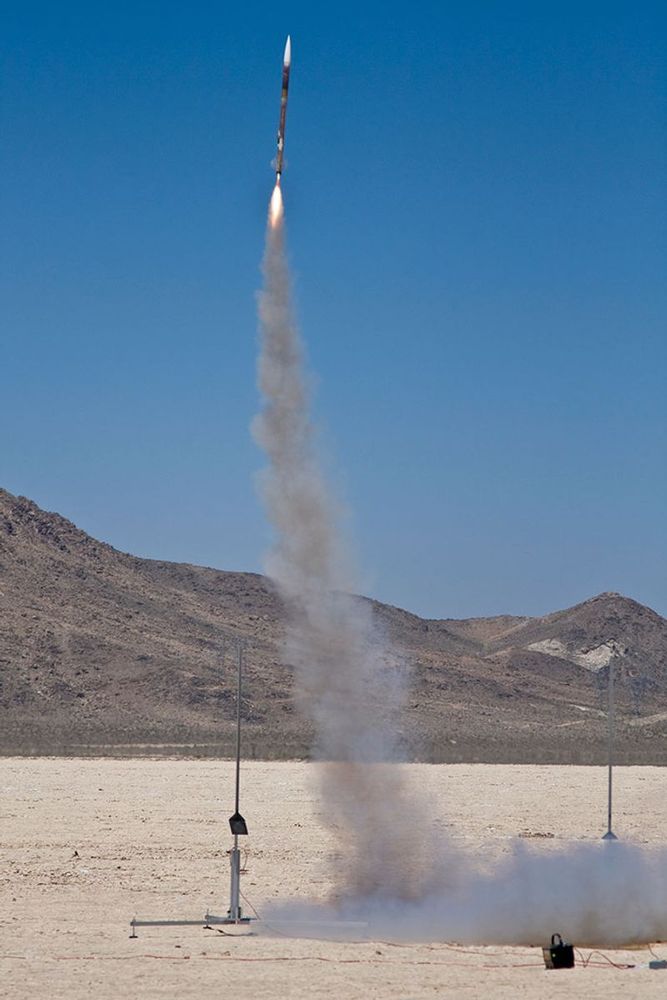
Many countries are involved in technological and scientific discoveries in space. Models and prototypes are used to test new rocket designs.
A model rocket is launched to study the projectile for upcoming real-life space missions. It has a straight upward trajectory with an initial velocity of from a height of . The height , in metres, of the rocket, after seconds, is given by the equation .
If you were asked to determine the maximum height of the rocket and how long it takes the rocket to reach that maximum height, you may encounter some difficulties.
Let’s examine this problem and identify what they might be.
The following graph represents the function .
The horizontal axis represents time , in seconds. The vertical axis represents the height , in metres.
The horizontal axis represents time , in seconds. The vertical axis represents the height , in metres.
This parabola represents the height of the rocket, in metres, at time seconds. Notice that the vertex () is the highest point on the parabola. The -value of the vertex represents the time it takes for the rocket to reach the maximum height. Similarly, the -value of the vertex represents the maximum height of the rocket.
Unfortunately, the standard form equation, , does not give us any information about the vertex. We would need to use the vertex form to find out any information about the vertex.
In vertex form, which is , the and the can be used to infer the vertex. It is the point ().
In order to convert from standard to vertex form, we use a process called completing the square.
When we expand and simplify the squared binomial from vertex form to standard form, we get a perfect square. We will use that in order to go from standard form to vertex form. This is where the name ‘completing the square’ is derived.
Example 1
Complete the following and check your solution with the suggested answers.
Jasleen is
swinging on a swing-like elastic bungee cord. The parabolic path is modelled by the equation
where is the height of the “swing” in inches and is the time in seconds.

Does this parabola have a maximum or minimum point? How do you know?
It will have a minimum point because it opens up since a>0.
"How close will she get to the ground when she is swinging? What point is this asking us to find?
This asks us to find the h value of the vertex (t,h) because it wants the minimum point.
What form must we get the equation into in order to solve for the vertex?
Vertex form;
Step 1: Factor out ‘a’ from the first two terms.
Step 2: Determine the ‘c’ value that would make the terms in brackets a perfect square trinomial.
The c value will be 9.
Step 3: Create the perfect square trinomial.
We must keep the equation equal to the previous step, so after we add that c value, we also must subtract it.
Step 4: Multiply the subtracted ‘c’ value by the ‘a’ value to leave just the perfect square trinomial in the brackets.
Step 5: Factor the perfect square trinomial and simplify.
How close will Jasleen get to the ground?
Jasleen will be 7 inches above the ground at the lowest point.
Example 2
From February 2017 to April 2018, the average house price in Toronto increased, then decreased. This is modelled by the equation , where P is average purchase price in thousands of dollars and x is the number of months (note that x = 0 is February 2017). Determine the maximum average purchase price and in which month this occurred.
We want to find the vertex so we must complete the square.
The vertex (x, P) is (4.5, 621.5), therefore the maximum average purchase price is $621,500 and this occurs 4.5 months after February 2017, in June 2017.

Self-check
Rate your level of understanding from 1 (I am still confused) to 5 (I fully understand this concept) based on your results from the questions you just completed.
I am able to:
If there are any criteria where you rated your level of understanding a 3 or below, you should review the concepts before moving on to the next learning activity.
Let us now review and practice the concepts from this learning activity(Opens in a new window)
Math journal

At the end of the course, you will fine-tune 8 entries (two from each unit) from your math journal and submit them as your “Culminating Assessment - Math journal.” (Opens in new window)
In your math journal, summarize the three forms of quadratic functions. Include the equation and what can be found from each form. Also include how to convert from one form to the next with an example. Your summary resemble the following table.
| Form | Equation | Information from this form | How to convert to standard form | How to convert to factored form | How to convert to vertex form |
|---|---|---|---|---|---|
| Standard | |||||
| Factored | |||||
| Vertex |
Summary of converting an equation of a quadratic function to vertex form
This method is referred to as completing the square. To convert an equation of a quadratic function to vertex form:
- Factor from the first two terms
- Determine the value that will make the terms into a perfect square trinomial .
- Add and subtract the value into the brackets.
- Remove the subtracted value from the brackets by multiplying it with the factored value.
- Factor the perfect square trinomial and simplify.
In an earlier learning activity you were shown the quadratic formula. You learned in the minds on that when you rearrange the quadratic formula you are left with the standard form of a quadratic. In this extension, you will find out how we can develop the quadratic formula from standard form.