
In this learning activity, you will be introduced to the laws of exponents, specifically when exponents are positive integers, negative integers and rational numbers. As you have learned in past courses, the exponent of mathematical expression determines how many times a number is multiplied by itself.
Think

There are many examples in our lives where we can notice exponential growth. Exponential growth is when a relation is growing at an increasingly rapid rate for each change in independent value. Try to come up with a list of situations that you are familiar with that display this type of rapid growth.
A common example of exponential growth is when diseases are untreated. To explore an example of exponential growth in progress, you may choose to play the game "Solve The Outbreak(Opens in new window)" from the CDC – Centres for Disease Control and Prevention. Use your preferred internet search engine to find the game, which provides examples of exponential growth in a real-world scenarios. (Try the level 1 activities).

Review of powers
Before we review exponent laws, it is important to know the terms associated with these laws. The following example shows an expression that is composed of a coefficient and a power.
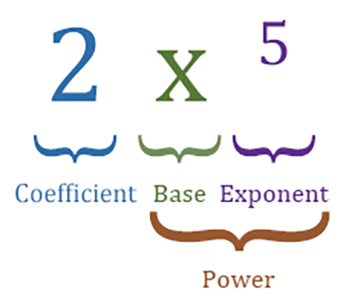
A power can also be represented as a product; the base multiplied by itself the number of times as the exponent. The product of the power in the above example would be the base, multiplied by itself 5 times, the value of the exponent.
Notebook

Complete the following questions in your notebook and compare your answer with the suggested solutions.
- For each of the following powers, indicate the base and the exponent.
The base is and the exponent is .
This law will be explained later, but it is considered proper communication to not include a visible ‘1’ exponent.- Represent a power using the given base and exponent. Then indicate each power in expanded form.
Power:
Expanded form:Power:
Expanded form:Power:
Expanded form:Power:
Expanded form:- Shorten each of the following expressions by representing it as a power.
Your scientific calculator can be used to evaluate powers. If you do a quick online search, you will discover that your phone and computer also can calculate powers using a free calculator app. The appearance of the exponent button varies from calculator to calculator, but common ones include [^] and [xy]. When dealing with fractions, use the brackets buttons. In the case of negatives, if the base is in brackets, then use the brackets on your calculator as well. If you are having difficulty, consult your manual for specific instructions.
- Use a scientific calculator to evaluate each of the following powers.
In previous math courses, you had to use some of the exponent laws but you may not have used them recently. Take a moment now to review these nine exponent laws.
Notebook
Complete each of the following questions about each of the nine exponent laws in your notebook. Compare your work with the suggested answers to check your understanding.
Think
Do you notice a pattern in the examples we just worked through, when comparing the original question to the final answer with a single power?
The exponent in the final answer is the sum of the exponents in the original question.
What would the rule be for multiplying powers with the same base to get a single power for the example ?
This rule applies for multiplying many powers with the same base:
Think
Do you notice a pattern in the examples when comparing the original question to the final answer with a single power?
The exponent is applied to each part of the product of the base.
What would the rule be for multiplying powers with the same base to get a single power for the example
This rule applies for bases with many products:
Law 4 – Powers of powers
Notice in the following examples that the base is a power. The base is everything in the brackets.
Expand each of the following powers and then represent the product using a single base in your notebook. Compare your answers with the suggestions provided.
Think
Do you notice a pattern in the examples when comparing the original question to final answer with a single power?
The exponents are multiplied by each other.
What would the rule be for multiplying powers with the same base to get a single power for the example
This rule applies for bases with products and powers:
Law 5 – Dividing powers with the same base
When dividing powers with the same base, the key is subtracting rather than adding exponents.
Expand each of the following powers and then reduce to express each quotient as a power with a single base in your notebook. Compare your answers with the suggestions provided.
Think
Do you notice a pattern in the above examples when comparing the original question to final answer with a single power?
The exponents in the final answer are the difference between the first exponent and second exponent.
What would the rule be for dividing powers with the same base or
or
This rule applies for dividing many powers with the same bases
Law 6 – Exponent zero
The exponent zero law indicates that bases with exponents of zero are equal to one.
Expand each of the following powers and then reduce to express each quotient as a power with a single base in your notebook. Compare your answers with the suggestions provided.
Repeat the same examples law 5 – dividing powers with the same bases.
Think
Do you notice a pattern in the examples when comparing the final answers in both exercises?
Any power with exponent 0 is equal to 1.
What would the rule be for any number (a) with exponent zero such as
= 1
Law 7 – Powers of a quotient
When you divide two powers with the same base, you need to subtract the exponents.
Expand each of the following powers and then reduce to express each as a quotient of powers in your notebook. Compare your answers with the suggestions provided.
Think
Do you notice a pattern in the above examples when comparing the original question to the final answer with a quotient of powers?
What would the rule be for powers of a quotient
Law 8 – Negative exponents
The negative exponent rule tells you to only move negative exponents in the denominator, transforming them into positive exponents in the process.
Expand each of the following powers and then reduce to express each quotient as a power with a single base in your notebook. Compare your answers with the suggestions provided.
Repeat the same examples using law 5 – dividing powers with the same bases.
Think
Do you notice a pattern in the above examples when comparing the final answers in both exercises?
For negative exponent, take the reciprocal of the base (flip the base) to make the exponent positive.
What would the rule be for writing a power with a negative exponent as a power with a positive exponent
This rule also applies to rational bases.
Putting laws 1 to 8 together
So far, you have reviewed the following laws:
- Exponents of 1
- Multiplying powers with the same base
- Powers of products
- Powers of powers
- Dividing powers with the same base
- Exponents of 0
- Powers of a quotient
- Negative exponents
Explore this!

Let’s explore the following video, which will help you better understand these laws and how to put them into practice:
Example: Solve applying Exponent Laws.
Solution: Add two powers of 5 in numerator. In denominator there is power of power, so exponents are multiplied.
Law 9 – Rational exponents
A rational number is any number that can be expressed as a fraction whose denominator is not 0.
A rational exponent is a fractional exponent of the form , where is the power and is the index.
In your notebook, simplify the following:
Evaluate the following:
Think
Do you notice a pattern in the above examples when comparing the final answers in both exercises?
The final answers are the same so
What would the rule be for writing a rational exponent as a radical ?
This rule also applies to other rational exponents.
So, now we have learned that the rational exponent can be written as the radical .
Determine the general rule for any power with a rational exponent to be written as a radical ?
Where , can be any positive integer. Where , can be any odd positive integer.
Represent each of the following expressions as a power.
Evaluate each power
For the following, indicate each power as a radical and then evaluate mentally or by using a calculator. To find the nth root of a number using your calculator, look for a button that resembles or . If you are having difficulty, consult the manual for your calculator.
Express each of the following radicals as a power with a rational (fractional) exponent. Reduce the fractional exponents whenever possible.
For each of the following powers with fractional exponents, evaluate mentally or by using a calculator.
Represent the following as a single power, then evaluate.

Self-check
Rate your level of understanding from 1 (I am still confused) to 5 (I fully understand this concept) based on your results from the questions you just completed.
I am able to:
If there are any criteria where you rated your level of understanding a 3 or below, you should review the concepts before moving on to the next learning activity.
Math journal

At the end of the course, you will fine-tune 8 entries (two from each unit) from your math journal and submit them as your "Culminating Assessment - Math Journal" (Opens in new window).
In your math journal, summarize the exponent laws. Your summary may resemble the chart below.
| Law name | Law | Example |
|---|---|---|
| Exponents of 1 | ||
| Multiplying powers with the same base | ||
| Powers of powers | ||
| Dividing powers with the same base | ||
| Exponent of 0 | ||
| Powers of a quotient | ||
| Negative exponents | ||
| Rational exponents |
Try it!

Once you feel confident with the success criteria, complete the following questions.
Portfolio
In your notebook, simplify the following expressions using the laws of exponents, then evaluate.
Simplify the following expressions using the laws of exponents, then evaluate.
Submit your portfolio item(s) by pressing the “Go To Portfolio” button.
 (opens in a new window)