In this learning activity, you will learn to identify the difference between simple and compound interest. You will be able to solve problems that involve calculating simple and compound interest.
Pre-assessment review:
Check your prior knowledge of the following terms and conversion techniques related to finance that you will encounter in this learning activity.
Try it!

How would you define the term ‘invest’ in relation to finance?
When you invest you put money into something (for example a property, financial product, gold, etc) with the hope of increasing its value.
What does the term ‘interest’ mean in relation to finance?
Whenever you invest or borrow money you will either earn money on the investment or have to pay money on the loan. The money that is earned or paid is called interest.
What does the term ‘loan’ mean in relation to finance?
A loan is a sum of money that is borrowed from a lender with the expectation that the money will be repaid by the borrower to the lender over time. Typically, the lender will charge the borrower interest on the initial amount loaned.
How do you convert a percentage into a decimal?
To convert a percentage into a decimal you divide the percentage by . For example, can also be expressed as .
Explore this!

Let's explore the following videos which explain how to distinguish debts that have simple interest and debts with compound interest.
Summer savings with simple interest

Mara and Aram are a young couple who want to invest for their future. Concept of simple and compound interest has been explained by using their situations as examples. Aram worked during the summer vacation doing minor landscaping and cutting lawns. Instead of spending the paycheques, they decided to deposit the in a bank account that earns interest each year for six years.
At the end of each year, Aram received a cheque for the interest earned. Find out how much interest Aram earned in the following activity.
What is simple interest?
The interest that is either earned (or paid) on the original sum of money invested (or borrowed) is simple interest.
The sum of money that is borrowed or invested is called principal.
Explore this!
Explore the following video to find out more about simple interest.
What is the formula for simple interest?
The interest earned depends on three factors:
- Principal, (the money invested).
- Rate, (the annual interest rate).
- Time, (the time for which the money is invested).
This is the formula for calculating simple interest:
Formula for simple interest:
- is the interest earned in dollars.
- is the principal invested in dollars.
- is the annual interest rate, in decimal form.
- is the time in years.
Take note of the following equation, as you’ll need it to calculate the total amount of an investment over time.
When money is invested, the sum of the principal and the interest is called the amount of an investment.
- Amount is Principal Interest
- Formula:
To find out Aram’s interest each year for six years: first, we must convert to a decimal, . This is called the rate of interest. We then have to multiply the rate with to find the interest earned at the end of each year.
The following table shows the amount of interest Aram will earn each year.
| Year | Amount in account ($) | Suggested Solutions |
|---|---|---|
| 1 | ||
| 2 | ||
| 3 | ||
| 4 | ||
| 5 | ||
| 6 |
Notice that the amount of interest stays the same each year and so, it represents simple interest because the interest is not reinvested.
Only the original amount of , called the principal, earns interest each year. The interest earned is paid separately at the end of each year.
To determine the accumulated interest, add the interest earned at the end of each year. The last column in the following table shows the accumulated interest.
| Year | Amount in account ($) | Interest received ($) | Suggested Solutions |
|---|---|---|---|
| 1 | |||
| 2 | |||
| 3 | |||
| 4 | |||
| 5 | |||
| 6 |
Notebook

In your notebook, determine the pattern for the accumulated interest in each year and compare with the suggested solution.
Each value can be determined by multiplying 40 with the year number. Notice the following:
- For year 1, the accumulated interest is , or
- For year 2, the accumulated interest is , or
- For year 3, the accumulated interest is , or
- If the money was invested for 12 years, the accumulated interest would be or
Using the year number and accumulated interest values from the following table produce a graph of simple interest earned over time.
| Year | Simple interest ($) |
|---|---|
| 1 | |
| 2 | |
| 3 | |
| 4 | |
| 5 | |
| 6 |
Because the points form a straight line, simple interest represents a linear function. The slope of the line, which is 40, indicates that the simple interest increases at a constant rate of $40 per year.
Investing $2,000 prize using simple interest

Aram is a talented individual. To earn more money, Aram submitted a short story to a creative writing contest and won the top prize: a cheque for .
A term deposit is a fixed-term investment that locks your principal away until the term is over. Consider a situation in which Aram invested the in an 18-month term deposit account that paid per year. As noted earlier:
To find how much interest Aram earned, you need to identify the following elements:
- principal(p)
- rate(r)
- time(t)
Try it!
The principal is the initial amount invested. How much is Aram’s principal?
The principal is .
What is the interest rate? Convert this to a decimal.
The interest rate is .
As a decimal, .
What is the time? (This is time in years, so you may have to determine the fraction of a year.)
The time is 18 months.
Since there are 12 months in a year, then in years , or one and a half years.
Now you can use to find the interest. What is the interest?
Therefore, Aram earned $105 in interest.
In some problems you may have to solve for , , or .
Borrowing from a bank
Consider a situation in which Aram paid $165 in interest for borrowing a sum of money at an interest rate of annually for four years. Based on these values, calculate how much money Aram borrowed initially.
To calculate how much Aram borrowed you will have to first find the interest rate, the time, and the interest.
What was Aram's rate?
The interest rate is .
As a decimal, .
What was Aram’s time?
The time is years.
What was Aram’s interest?
The interest is .
Use the formula to find the principal.
The principal is:
Therefore, Aram borrowed .
The death of Mara’s great-aunt

Mara tells Aram that an inheritance is due from a great-aunt. Consider a situation in which Mara invests the inheritance of .
Mara decides to buy a seven-year, Guaranteed Investment Certificate (GIC) that earns per year.
Try it!
Determine the interest that Mara earned on the GIC.
Use the formula .
Substitute: , , and .
Therefore, Mara earned in interest.
What is the amount of the GIC at the end of seven years?
The amount of the GIC is .
Summer savings with compound interest

Earlier we learned that Aram deposited in an account that pays simple interest for six years. Let’s consider the interest received if interest had been reinvested back in Aram's account.
Each year, Aram receives , hence, at the end of six years total received interest is .
Suppose Aram reinvested the interest back into the account. Explore how this situation is different from simple interest. The table below represents the calculations for the amounts earned each year if Aram had invested in a compound interest account.
|
Year |
Principal for year (P) |
Interest earned (I) |
Accumulated interest ($) |
|---|---|---|---|
When Aram invested in a simple interest account, and earned a total of in interest over 6 years. In this new situation, by reinvesting the interest earned at the end of each year into the account, Aram now earns in interest over 6 years.
The interest difference between the two investments is . Therefore, Aram earns more in interest by adding it to the principal each year.
When interest is earned on interest, that interest compounds. This describes another type of interest—, compound interest.
In other words, interest calculated at regular periods and added to the principal for the next period is called compound interest.
Explore this!
Explore the following video to deepen your understanding of compound interest.
Compare simple interest and compound interest by investigating the amount of interest Aram earned on his in each situation. Examine the following two tables. Table A indicates the change in simple interest each year. Table B indicates the change in compound interest each year.
Table A: invested at simple interest.
|
Year |
Total interest |
Change in interest |
|---|---|---|
|
---------- |
||
Table B: invested at compound interest.
|
Year |
Total interest |
Change in interest |
|---|---|---|
|
---------- |
||
For simple interest, the interest increases by the same amount each year.
For compound interest, the interest increases by a greater amount each year. It is compounded annually. This means the yearly interest is added to the principal amount and reinvested, therefore gaining even more interest.
In each table, the third column, change in interest, represents the finite differences (specifically, the first differences). You may want to review finite differences.
You already know that simple interest represents linear growth, so it makes sense that the finite differences are constant.
In Table B, the values in the third column are not constant, which indicates that compound interest is not linear. You can confirm this by graphing Simple interest vs. Compound interest.
Notebook
Sketch the following graph in your notebook, use the values in columns 1 and 2 of Tables A and B.
Observe that in the first year, the blue diamond covers the green dot. The interest earned under simple interest and compound interest is the same.
After the first year, the compound interest earned is greater than the simple interest. Notice that the difference increases each year.
The graph confirms that compound interest does not represent linear growth.
Determine the ratio of finite difference to determine the type of function it represents (divide the change in interest for a given year by the change in interest from the year before) For example, the ratio of finite differences between year 2 and year 1 is .
| Year | Total interest | Change in interest | Ratio | Suggested solutions |
|---|---|---|---|---|
| 1 | ||||
| 2 | ||||
| 3 | ||||
| 4 | ||||
| 5 | ||||
| 6 |
Since the ratio of the change in compound interest is constant, then compound interest represents exponential growth.
Mara purchases a Guaranteed Investment Certificate (GIC)
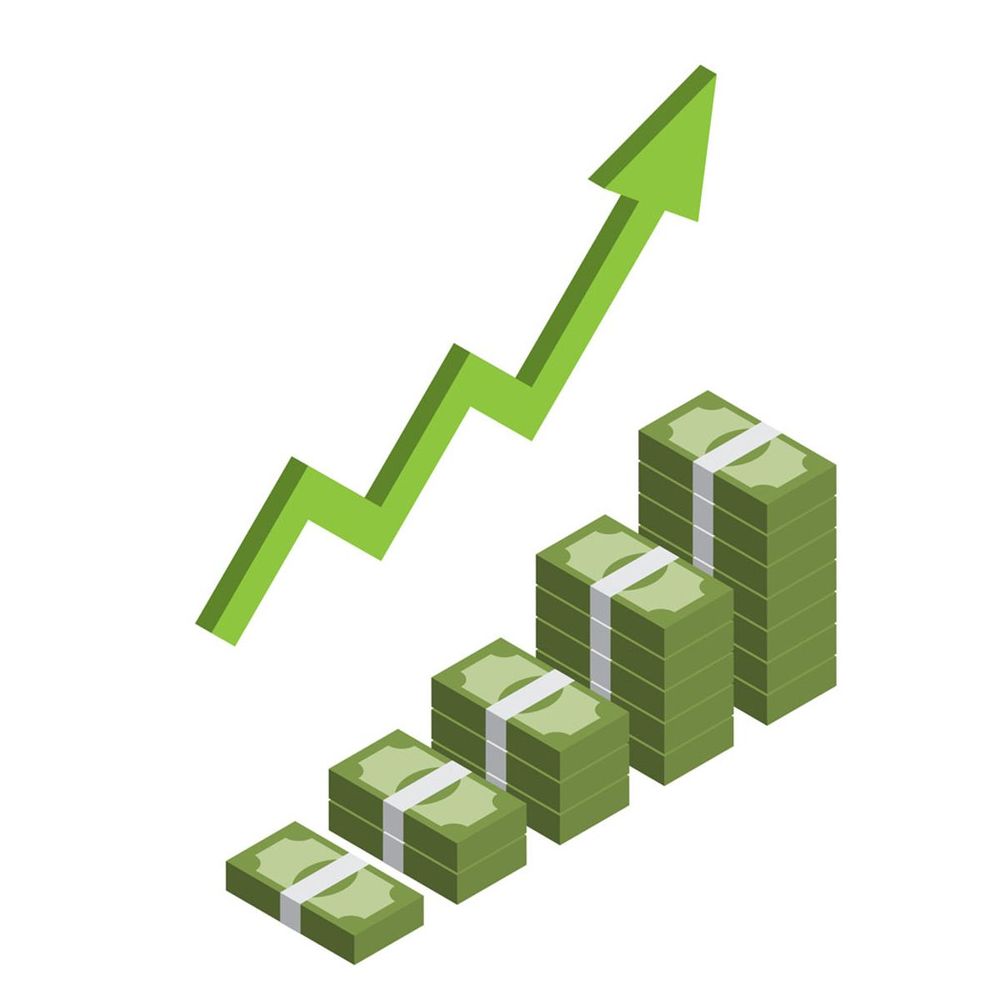
Money grows more rapidly when interest is compounded because it grows exponentially. Here’s an exercise involving compound interest.
Mara purchases a GIC that earns interest each year for eight years.
Determine the total interest earned at the end of each year using simple interest. Organize your calculations using the provided table.
| Year | Principal (P) | Simple interest (I) | Accumulated simple interest ($) |
Next, determine the total interest earned at the end of each year using compound interest. Organize your calculations using the following table.
| Year | Principal for year ($) | Compound interest ($) | Accumulated compound interest ($) |
Try it!
Determine the amount of the investment under simple interest.
Use the formula .
The amount for simple interest is:
Determine the amount of the investment under compound interest.
The amount for compound interest is:
How much extra interest is earned under compound interest?
From earlier, you know that the total amount of accumulated simple interest is and the total amount of accumulated compound interest is .
Subtract these two amounts:
Therefore, extra interest is earned under compound interest.
Solving compound interest problems
Here is a handy formula for solving compound interest problems when you want to know the total amount. With this formula, you do not need to add the interest earned to the principal because the formula does that step for you, automatically.
The formula of an investment when the interest is compounded is:
where:
- is the amount.
- is the principal.
- is the compounded interest rate as a decimal.
- is the number of compounding periods. For interest compounded annually, this is the number of years.
In the following examples, you will use the annual compounded interest formula and the Time Value Money (TVM) Solver.
Borrowing money to buy a laptop

To buy a new laptop for a home business, Mara borrows at an interest rate of per annum compounded annually. Mara plans to pay back the loan in three years.
Method 1: Using the formula
- How much will Mara owe in 3 years?
- How much interest will Mara owe after three years?
Use the formula .
, ,
So, at the end of three years, Mara will owe .
How much interest will Mara pay for the loan?
The interest is the amount paid after three years less the money borrowed.
Therefore, the interest for the loan is .
Method 2: Using TVM solver
This type of problem can also be solved with a financial calculator. This method is particularly helpful when solving more difficult problems such as a payment deal in which the lender is misleading you about the actual interest rate. In your case, you’ll get to use the TVM solver.
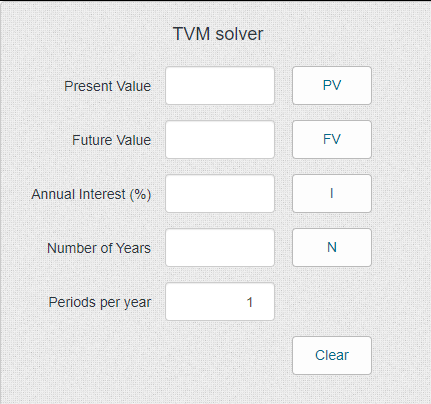 Start (Opens in a new window)
The TVM solver can help you calculate the various parameters related to compound interest. It’s based on the future value of TVM equation:
This is similar to the equation for compound interest.
This is not by accident!
Let’s examine each component of the TVM equation to find out how they relate to what you already know about the compound interest equation.
The variable A (the total amount of an investment or debt load) is called the “future value” or FV, because the total amount is the value at the end of the term, after it has accumulated interest.
P (the principal) is called “present value” or PV, because the principal is the amount of money at the beginning of an investment or loan, before any interest has accumulated.
The variable I stands for the annual interest rate. This is independent of the number of compounding periods. The interest rate percentage is entered directly into the TVM solver.
The variable stands for the number of years interest is accumulating. This is the term of the investment or loan.
The “periods per year” refers to the number of compounding periods per year. The value you enter will depend on how the investment or loan is being compounded (yearly = 1, semi-annually = 2, quarterly = 4, monthly = 12, and so on).
Now, let’s take the TVM solver out for a test drive! The following is the same problem you saw previously. To buy a new laptop for a home business, Mara borrows at an interest rate of per annum compounded annually. The plan is to pay back the loan in three years.
- How much will Mara owe after three years?
- How much interest will Mara pay for the loan?
Can you solve the following problems on your own using the TVM solver? Give it a shot and examine.
Start (Opens in a new window)Try it!
How much will Mara owe after three years?
To find this number, you enter the following values into the TVM Solver:
- Present value:
- Annual interest:
- Number of years:
- Periods per year: (recall that the interest is compounded annually)
Then press the FV button to find the Future Value. The future value (FV) is .
How much interest will Mara pay for the loan?
The interest is the amount paid after three years less the money borrowed:
Therefore, the interest for the loan is .
Mara dreams of university

In some problems, you want to know how much you should invest today to have a certain amount of money in the future.
In the following situation, Mara wants to know how much to invest today to cover tuition fees for her first year of university.
To find the principal or present value of an investment, you can rewrite the formula so is isolated. Try to rearrange the formula for , if you can.
In five years, Mara will need to cover tuition fees for first year of university. How much money should Mara invest today, at a rate of compounded annually, so that there is enough money to pay tuition fees?
Use the formula
- Substitute
- Substitute
- Substitute
Therefore, Mara should invest at today to have in five years.
Different compounding periods
For some investments or loans, the interest is compounded more than once a year. For instance, if you have money invested in a daily interest account, then the interest earned is compounded daily, or 365 times a year. The following table is a summary of possible compounding periods.
|
Frequency of compounding |
Number of times interest is added during a year |
|
Annually |
1 (every year) |
|
Semi-annually |
2 (every six months) |
|
Quarterly |
4 (every three months) |
|
Monthly |
12 (every month) |
|
Daily |
365 (every day) |
For these questions, the formula can still be used to determine amounts when the interest is compounded more than once a year; however, the interest rate must be divided by the number of compounding periods in order to find the amount of interest per compounding period.
Three different compounding periods for Aram’s investment
Aram now considers the option of three different compounding periods for his investment at 4% interest over 6 years: semi-annually, quarterly and monthly.
Try it!
Try determining the final amount when compounded monthly and compare your answer with the suggested solution.
What is the amount after six years, compounded monthly?
The principal is . The annual rate is . The time is six years.
When the interest rate is compounded monthly, it is added 12 times a year.
The monthly rate is of .
In six years, there are , or compounding periods.
To find the amount, use .
Substitute , , and .
The amount after six years compounded monthly is .
Which compounding period should Aram select? Justify your choice.
Since the largest amount occurs when the interest is compounded monthly, Aram should choose the monthly option to invest his .
Aram uses a TVM solver to dream big!
Use the TVM Solver to answer each of the following questions.
Start (Opens in a new window)Try it!
Aram is investing in an account that earns compounded monthly for seven years. What is the amount in the account at the end of this time?
To find this number, you enter the following values into the TVM Solver:
- Present value:
- Annual interest:
- Number of years:
- Periods per year: (recall that the interest is compounded monthly)
The future value (FV) is .
Aram plans for a big anniversary
Aram attends a major sporting arena and wins the 50/50 charity drawing happening that night. As a result, goes to helping children with special needs sporting groups and is the prize that was awarded to Aram, who really wants a motorcycle.

Aram now has to invest for five years. At the end of five years, Aram would like to have to buy a new motorcycle. What rate of interest, to the nearest hundredth of a percent, compounded quarterly, does Aram need to achieve the goal?
To find this rate of interest, you enter the following values into the TVM Solver:
- Present value:
- Future value:
- Number of years:
- Periods per year: (recall that the interest is compounded quarterly)
Aram needs a rate of interest of to achieve his goal.
Simple and compound interest practice problems
- International Express (a non-existent credit card company) charges an annual interest rate of on unpaid account balances. Calculate the amount of interest that the company would charge when a balance of is paid days late.
The principal is .
The interest rate is . As a decimal, .
The time is days. Since there are days in a year, then in years,
Substitute these values into the formula and solve for .
The company would charge in interest.

- Aram borrowed for eight months to buy a new car and paid in interest on the loan. What was the annual interest rate of Aram’s loan?
Determine the interest rate, .
The principal is .
The time is months. Since there are months in a year, then in years
The interest is .
Substitute these values into the formula and solve for .
The annual rate of interest of Aram’s loan was .
- In your notebook, describe the difference between simple and compound interest. What type of growth does each represent? Explain.
Simple interest is paid annually on the principal and is not reinvested. Compound interest is earned annually but is reinvested with the principal, so interest is earned on interest. Simple interest accumulates at the same rate and represents linear growth. Compound interest accumulates at a rate that has a constant ratio and represents exponential growth.
- Aram purchases a Canadian Savings Bond that earns interest each year for five years.
If you would like to learn about Canadian Saving Bonds, use your favourite internet search engine and enter the terms “Canada Savings Bonds” and “interest earned”. 2021 is a unique year to be learning about these bonds!
Determine the total interest earned at the end of each year under simple interest. Organize your calculations using the following table.
|
Year |
Principal ($) |
Simple interest ($) |
Accumulated simple interest ($) |
Determine the total interest earned at the end of each year under compound interest. Organize your calculations using the following table.
|
Year |
Principal for Year ($) |
Compound Interest ($) |
Accumulated Compound Interest ($) |
How much extra interest is earned under compound interest?
From earlier, you calculated the total amount of accumulated simple interest as . You also calculated the total amount of accumulated compound interest as .
Subtract these two amounts: .
Therefore, the extra interest is earned under compound interest.
Determine the amount of the investment under simple interest.
Use the formula .
The amount for simple interest is:
Determine the amount of the investment under compound interest.
Use the formula .
The amount for compound interest is:
- Determine the change in interest for simple interest and compound interest. Organize your calculations using the following tables.
Table A – Simple interest: invested at
|
Year |
Total interest |
Change in interest |
| - |
Table B – Compound interest: invested at
|
Year |
Total interest |
Change in interest |
Try it!
Determine the ratio of the change in compound interest.
To find the ratio of the change in compound interest, use the tables above and divide consecutive values in column 3 as shown here:
,
,
Describe the type of growth represented by each table. Justify your answer.
Using a pencil and paper, plot Year against Total interest for simple and compound interest on the same grid.
Aram invested at compounded semi-annually.
Determine the amount of the investment after four years.
When the interest is compounded semi-annually, it is added twice a year.
The semi-annual rate is of .
In 4 years, there are , or compounding periods.
To find the amount, use .
Substitute , , and .
The amount after four years is .
What was the amount of the investment after seven years?
When the interest is compounded semi-annually, it is added twice a year.
The semi-annual rate is of .
In 7 years, there are , or compounding periods.
To find the amount, use .
Substitute , , and .
The amount after seven years is .
How much interest was earned on the investment between the fourth and the seventh year? Explain.
To determine the interest that was earned on the investment between the fourth year and the seventh year, subtract:
Therefore, was earned in interest between the fourth and seventh year.
How much money should Mara invest now at a rate of compounded monthly, to have in five years?
You know that the future value of the investment is .
Determine the amount that Mara must invest today (the present value).
Use the formula .
Substitute .
The monthly rate is of .
In 5 years, there are , or compounding periods.
Therefore, Mara should invest at today to have in five years.
Aram has to invest in a GIC that earns per year, compounded daily. How long will it take for Aram’s investment to double? Verify your answer using the TVM Solver.
The principal is . Since Aram wants to double the investment, then .
The daily interest rate is of .
Let represent the number of years it takes for the investment to double in value.
In years, there are , or compounding periods.
To find the number of years, use .
Substitute , , , and .
Use trial and error to find the value of .
Since which is very close to , then and so .
Convert to years and months.
is years and months.
Therefore, it takes approximately years and months for Aram’s investment to double.

Connections
Aram compares saving now vs. saving later
Explore the following video to better understand savings over time.
If you start at age 20, deposit per year at compounded annually, you will have at age 65. If you start at age 50, deposit per year at compounded annually, you will have at age 65.
Obviously, the first option is more profitable, so the sooner you can start saving, the better.
Rate your understanding on a scale of five to one.
Five means “I have a thorough understanding.” One means “I am confused.”
Are you able to:
Reflection questions:
Now that you’ve completed this activity relating to simple and compound interest, contemplate the following questions to help you extend your understanding and consider how this knowledge and set of skills may relate to and impact your own life and the lives of others.
- Why is it important to you to learn about some of the financial applications of mathematical functions?
- How might you apply what you’ve learned in this activity to impact your own: education, home-life, work-life and community?
- Consider some ways that you could use information and skills from this activity to help improve the lives of others both locally and globally.
- Reflect on how an understanding of simple and complex interest could help you achieve potential future career goals.
Join the discussion

Share your thoughts and answers to the reflection questions with your classmates to show your learning.
Press the “Join The Discussion” button when you’re ready to engage.

(opens in a new window)