
In this learning activity, you will learn to use trigonometric ratios to find the side length and angles of right triangles. You will also learn to use trigonometric ratios to solve real-life problems.
Hipparchus
The Greek mathematician Hipparchus compiled the first known trigonometric table and used it to solve problems more than 2100 years ago. He wrote down the rules of trigonometry when he was solving problems in astronomy, geography, and navigation.
Today, trigonometry is used to construct buildings, plan space missions, and solve problems in a variety of disciplines such as physics, chemistry, and engineering.
In previous courses, you have learned about right triangles. You also learned about the Pythagorean theorem that allowed you to solve for an unknown side when given the other two sides.
Try it!

Consider what you've learned previously about the Pythagorean theorem and try to record the equation that relates to it.

Primary trigonometric ratios
Let’s review some essential trigonometry concepts. For any right triangle, there are three important ratios called the three primary trigonometric ratios. They are: sine, cosine, and tangent ratios. These ratios describe a relationship between the angles and sides in a right triangle.
Note that any ratio, , can be represented as a fraction, , or as a quotient, . So the trigonometric ratios represent a quotient of the lengths of two sides in a right triangle. The hypotenuse is always the longest side of a right triangle and is located across from the angle.
Explore this!

Explore the following video to learn more about trigonometric ratios and finding the missing sides of triangles.
The primary trigonometric ratios can be used to find unknown angles or unknown sides for right triangles. The angle you wish to determine is labeled (read as “theta”). This is called the reference angle.
For an angle in a right triangle, the length of the opposite side divided by the length of the hypotenuse is known as sin (read as “sine theta”). It’s important to note that the location of the angle determines which side is opposite .
In the following diagram, notice that the unknown angle is on the right side and that is the angle you will want to calculate.
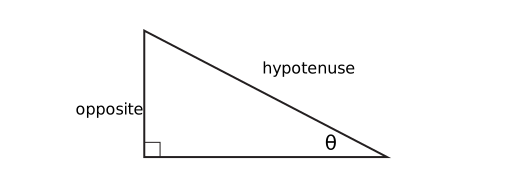
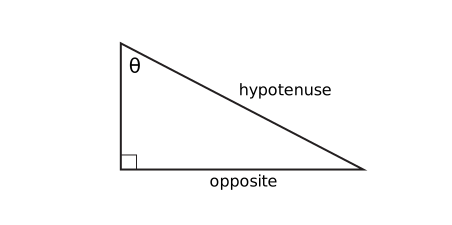
In the following diagram, the unknown angle is the uppermost angle. The base of the triangle is now opposite . Remember, In a right triangle the hypotenuse is always the longest side and is located across from the angle.
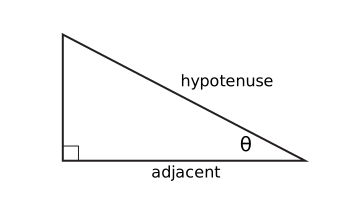
For an angle in a right triangle, as depicted in the following diagram, the length of the adjacent side divided by the length of the hypotenuse is known as cos (read as “cose theta”).
For an angle in a right triangle, as depicted in the following diagram, the length of the opposite side divided by the length of the adjacent side is known as tan (read as “tan theta”).
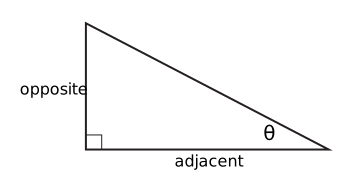
These three relationships can be summarized using the following three ratios for sine, cosine, and tangent.
Definition of the three primary trigonometric ratios
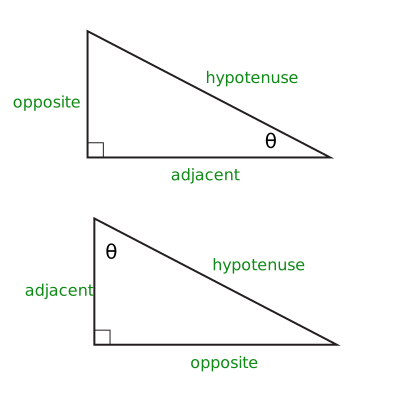
For a given angle in a right triangle, the three primary trigonometric ratios are as follows:
You may wish to use the mnemonic acronym “SOH CAH TOA” to help you learn the trigonometric ratios.
Working with your calculator
Be sure to set your calculator to degree mode for angle calculations.
If you are unsure of how to do this, you may need to consult your user manual as not all calculators are the same. Angles can be measured in degrees, radians, and gradians. In this course, you’ll always use degrees, and this is the default setting for most calculators. If you are continually getting the wrong answers, this may be something to check.
Try it!
Complete a table like the following by using your calculator to determine each ratio to four decimal places.
| Given angle | Trig ratio |
|---|---|
| 0.6820 | |
| 0.7071 | |
| 0.2079 | |
| 0.5774 | |
| 0.2126 | |
| 0.8660 | |
| 0.5592 | |
| 0.1736 |
In the previous exercise, you were given the angle. What if you know the ratio, but you don’t know the angle’s measurement? In the following exercise, the various angles are not given; however, the trigonometric ratios are given. You will need to find the angles using a calculator. For instance, you will determine ∠A given that the sine of A is 0.3 (sin A = 0.3).
Important calculator tip
When the angle is not given, use the 2nd key (sometimes labeled SHIFT) on your calculator, followed by the appropriate trigonometric key.
This gives you access to sin-1, cos-1, and tan-1, which are sometimes referred to as inverse sine, inverse cosine, and inverse tangent respectively.
Definition

Inverse refers to an operation that undoes a previous operation. For instance, when you tie your shoelaces, the inverse operation is to untie them. The inverse operation of addition is subtraction, of division is multiplication, and so on.
These three inverse trigonometric functions are required when you are given a ratio and asked to find the angle measure.
Explore this!
Explore the following video to learn more about missing angles and inverse trigonometric functions.
Let’s practice using inverse trigonometric functions with the help of the following exercise.
Try it!
Use your calculator to determine the size of angles A through H in the following table to the nearest degree.
HINT: To determine each ratio, use a calculator. Press the 2nd or INV key (depending on your calculator), followed by either SIN, COS, or TAN and then the number. For example, the first term in the following table would require pressing INV, SIN, 0.2875 then =.
| Trig ratio | Angle |
|---|---|
| sin A = 0.2875 | A = 17° |
| sin B = 0.9213 | B = 67° |
| cos C = 0.8990 | C = 26° |
| tan D = 0.3567 | D = 20° |
| tan E = 0.3245 | E = 18° |
| sin F = 0.0875 | F = 5° |
| cos G = 0.4569 | G = 63° |
| cos H = 0.1589 | H = 81° |
So far, you’ve reviewed how to find the trigonometric ratio when you know the angle measure, and find an angle when you know the trigonometric ratio. Sometimes, however, you are given a diagram with some measurements missing or unknown. When solving right-triangle problems, you may need to use one or both of these skills to find the unknown measurements.
Notebook

For the following two triangles, use your notebook and find the measure of . Round to the nearest whole number (which represents the nearest degree), and check your work with the suggested answers provided.
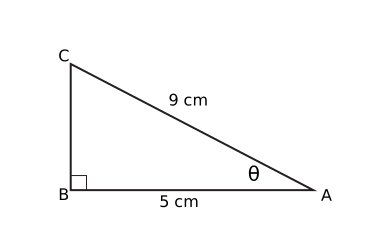
Since the sides given are the hypotenuse and the adjacent, use the cosine ratio.
There are several ways to find angle :
- using brackets
- dividing to find the decimal
- using the fraction button which may look like or ⬜/ ⬜
Therefore, .
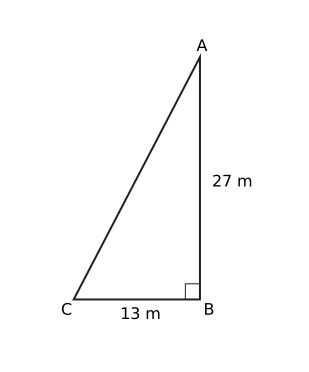
Since the sides given are the opposite and the adjacent, use the tangent ratio.
You do not need to convert the fraction to a decimal. You can use the brackets buttons on your calculator to enter the fraction using the division key. A fraction means to divide.
Therefore, .
Notebook
For the following two triangles, use your notebook to find the unknown length. Round to one decimal place, and check your work with the suggested answers provided.
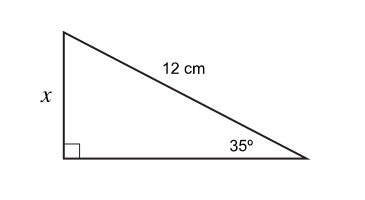
Since the side given is the hypotenuse and the side you want is the opposite, use the sine ratio.
Therefore, .
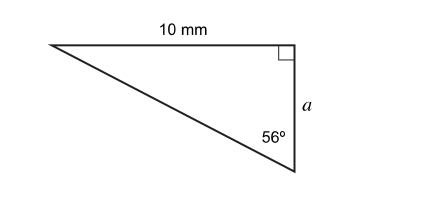
Since the side given is the opposite and the side you want is the adjacent, use the tan ratio.
Therefore, mm.
The Pythagorean theorem
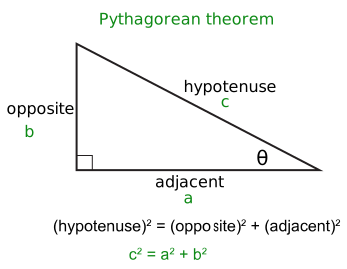
We can use the Pythagorean theorem to solve right triangles. This theorem states that for any right triangle, the square of the length of the hypotenuse is equal to the sum of the squares of the lengths of the other two sides (called legs of a right triangle).
You’ll use the Pythagorean theorem in the exercise that follows to assess the accuracy of your calculations. In some problems, the right-triangle diagram is not given; you are required to draw and label the triangle based on given information.
In trigonometry, it is customary to use upper case (capital) letters to name the angles. The side across from an angle is named with the same letter using a lower case letter.
Try it!
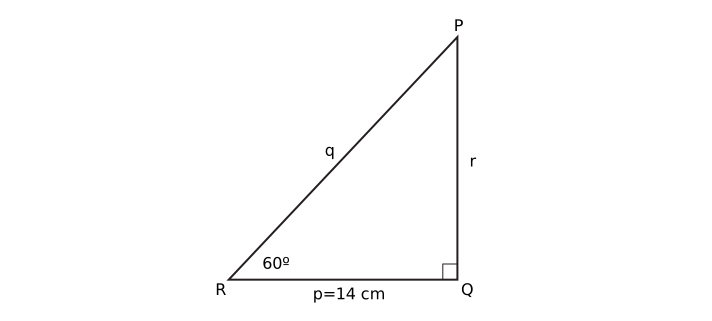
Given the following triangle with , , and , determine the length of and , to the nearest cm. Three methods are indicated in Step 3. (Each method will give you a slightly different answer. This is because and 14 cm have been rounded to the nearest whole number for ease of calculation.)
Step 1: Draw and label the triangle
Label the vertices , , and such that the angle is at . Label the side across from (or opposite) with the lower case letter . Label the side across from with the lower case letter , and label the side across from with a lower case letter as depicted in the following diagram.
Step 2: Find the value of
Since you know and the adjacent side , then to find , which is opposite , use the tangent ratio.
Therefore cm.
Step 3: Find the value of
There are at least three ways to find the value . You can use the sine ratio, the cosine ratio, or the Pythagorean theorem. Try using all three and compare your solutions to those provided.
Method 1. Using the sine ratio…
Therefore, to the nearest cm, .
Method 2. Using the cosine ratio…
Method 3. Using the Pythagorean theorem…
Therefore, to the nearest cm, .
Notebook
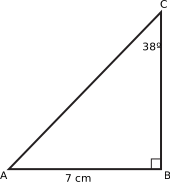
As you become more experienced, you will notice that there is often more than one way to determine an unknown value of a triangle. In the following exercise, you are asked to solve a triangle, which means that you must determine all the unknown angles and side lengths.
Solve the following triangle in your notebook and round your answer to one decimal place. Check your work with the suggestions provided.
To solve this triangle, find the lengths of , , and the measure of .
Step 1: Label the triangle
Use the lower case letter to label side as , and side as .
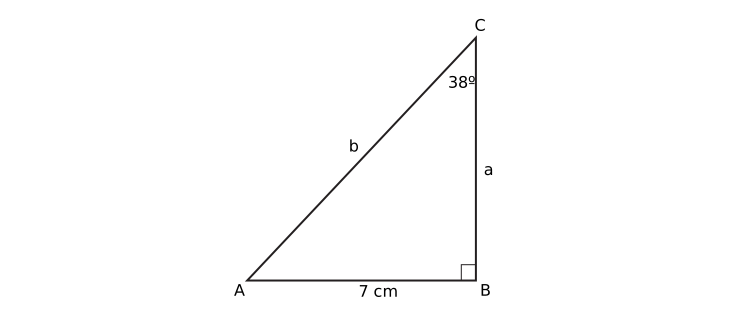
Step 2: Find the measure of
Since all the angles in a triangle add up to , then
Therefore, .
Step 3: Find the length of
There are at least two methods for determining the length of .
Method 1. Find the length of using
Since is adjacent to and is opposite , use the tangent ratio:
So .
Method 2. Find the length of using
Since is opposite to and is adjacent to , use the tangent ratio.
So .
Step 4: Update the diagram with the new information
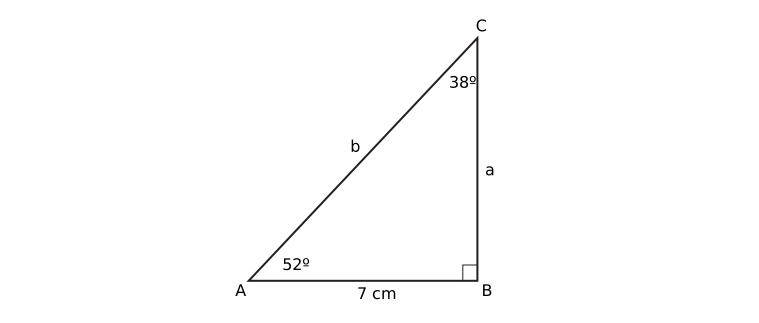
Step 5: Find the length of
There are many ways to determine the value of .
First, using the Pythagorean theorem:
Second, using the trigonometric ratios as shown here:
or or or .
Therefore, .
Solving right triangle problems
When solving problems involving right triangles, you will be required to draw a diagram based on given information. Understanding the wording of the problem is essential to obtaining the correct diagram. The following terminology should help you correctly interpret the problem.
Angle of elevation (or inclination)
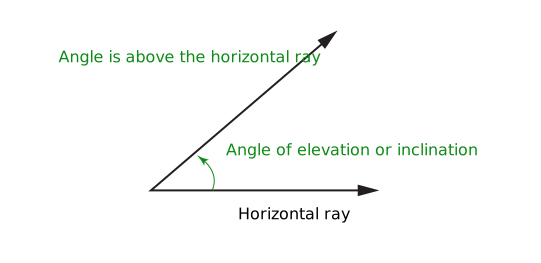
Angle of elevation is an angle formed between a ray and the horizontal such that the angle is above the horizontal ray. You can assume that “the horizontal” is the ground or is a plane that lies parallel with the ground as depicted in the following diagram.
Angle of depression (or declination)
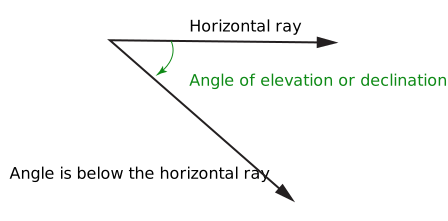
Angle of depression refers to an angle formed between a ray and the horizontal such that the angle is below the horizontal ray as depicted in the following diagram.
Directions – north, east, south, west
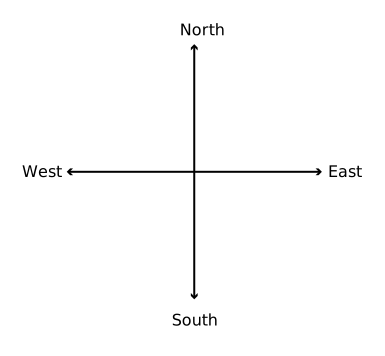
Angles may be given in terms of compass directions related to north, south, east, or west as depicted in the following diagram. A direction that is expressed as “due north” (or due south, or east, or west), indicates that the position is directly on the axis that points toward north (or south, or east, or west).
Other positions may fall between due north and due east (or between east and south or south and west or west and north). For your purposes, it is not necessary to use a protractor to measure the exact angle. You may simply estimate the correct position for the given angle.
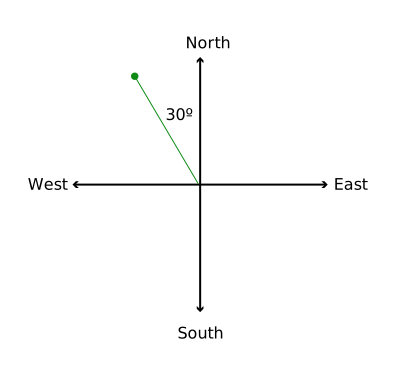
To find the position for a direction that is given as N 30° W, you first point due north, from the origin, and then move 30° to the west. Mark a point to indicate this position. Draw a line from the origin to this point, as shown in the diagram beside.
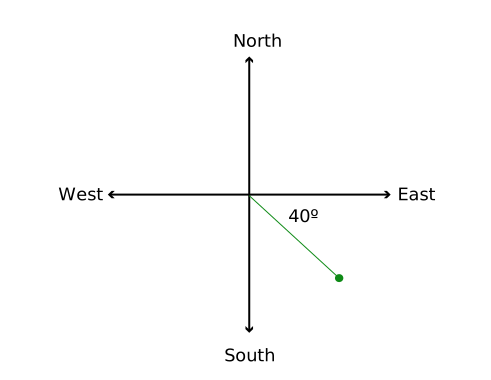
Similarly, to find the position for a direction that is given as E 40° S, you first point east, from the origin, and then move 40° toward south. Mark a point to indicate this position. Draw a line from the origin to this point, as shown in the diagram beside.
Units and distance
If the given units (for instance, hours and minutes or km and cm) in a problem are not the same, be sure to convert the measurements to the same unit before attempting to solve the problem. In the exercise that follows, the formula that relates distance, velocity, and time is used to find the lengths of the sides of the triangle formed in the given problem.
Distance formula
or
Try it!
A canoe leaves a shore at 12 noon. It travels east for 30 min at 3 km/h and then heads north for 15 min at 4 km/h. Using this scenario, answer the following questions.
To calculate distance, you can use the formula: distance = velocity × time, or .
The canoe travels east at 3 km/h for 30 min.
Convert 30 min to hours: = 0.5 hrs.
The canoe travelled 1.5 km east.
The canoe travels north at 4 km/h for 15 min.
Convert 15 min to hours: hrs.
The canoe travels 1 km north.
Let represent the shore. The canoe travels east for 1.5 km to point and then heads north for 1 km to point . Your diagram should be similar to the following.
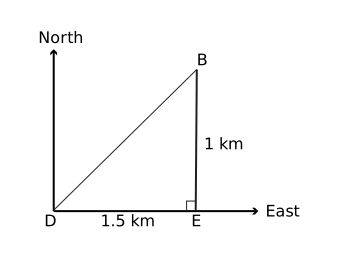
In geometry, another way to name an angle is to include the three points (sequence of three letters) that form it. For example, could also be called or given that the letter is always in the middle of the three-letter sequence.
The canoe’s location relative to the shore is represented by . Since you know the length of the opposite and adjacent sides in relation to this angle, use the tangent ratio.
Let’s indicate this angle on the diagram:
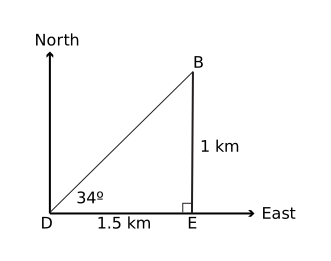
Therefore, the canoe is located at a point that is E 34°N of the shore. (Since is and , an equivalent way to express this direction is N 56°E.)
The distance (or the length of line ) can be found using the Pythagorean theorem or a trigonometric ratio. Use the sine ratio.
Therefore, the canoe is 1.8 km from the shore.
Try it!
Some real-world problems involve more than one triangle, and you may be asked to solve for more than one unknown. In this case, after solving for one unknown, be sure to record the new information on the diagram so that it can be used to find the next unknown, as shown in the following exercise.

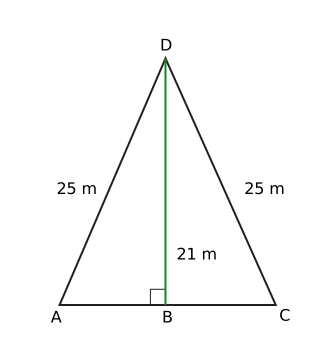
A 21 m tall communications antenna is to be anchored to the ground with two 25 m cables located on opposite sides of the antenna.
Let’s draw a diagram to represent the situation:
- Let represent the length antenna.
- It can be assumed that the antenna forms a angle with the ground.
- Let and represent the cables.
Determine each of the following and round your answers to one decimal place.
The angles between the two cables and the ground are and .
Since is isosceles (it has two equal sides), then .
You only need to find the degree measure of one of these angles.
Let’s find .
Therefore, each cable makes a 57.1° angle with the ground.
Since the cables are the same distance from the antenna, then .
Therefore, it is sufficient to find the distance and then multiply it by 2.
In , line is adjacent to (and ) and the hypotenuse is 25 m.
Therefore, the cables are 27.2 m apart.
Notebook
This following exercise demonstrates how to solve problems that involve more than one right triangle. This is a multi-step problem that requires you to find pieces of information not directly asked for in order to answer the question in your notebook. Check your progress with the suggested answers provided along the way.

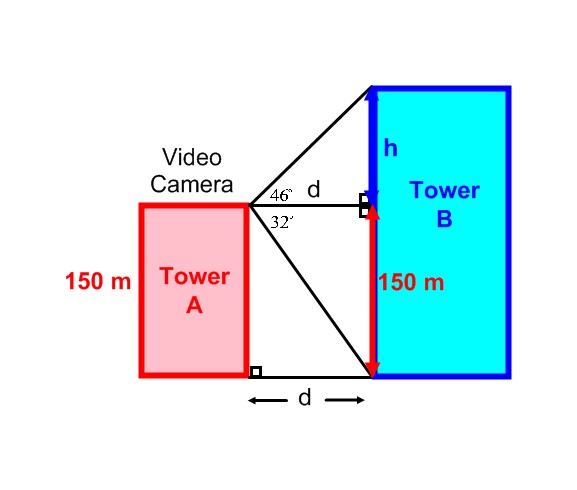
A flat parking lot is located between two office towers. A video surveillance camera is mounted on the top of Tower A, which is 150 m high. The camera is mounted horizontally but can be tilted up or down to view the parking lot or to observe Tower B. When the camera tilts down from the horizontal, it views the bottom of Tower B. When the camera tilts up from the horizontal, it views the top of Tower B.
In your notebook, draw a diagram to represent the problem. Check your drawing with the suggested answers provided.
Draw a horizontal line from the camera at the top of Tower A to meet Tower B at a angle. The distance from the bottom of Tower B to the horizontal is 150 m.
Let represent the distance between the two buildings. Note that can be measured either along the ground or along the horizontal line between the video camera and Tower B.
Let represent the remainder of the height of Tower B that is over 150 m.
Indicate the known angles, as shown in the following diagram.
Using this information, answer the following questions.
To determine the distance between the two towers, use the following triangle from the original diagram:
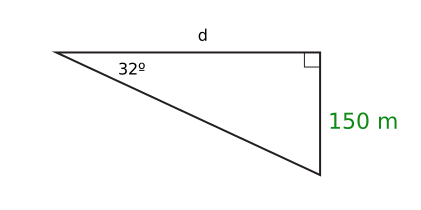
Therefore, the two towers are 240.05 m apart.
The total height of Tower B is . To determine , use the following triangle from the original diagram. Note that the value of found in the previous question has been included on the diagram.
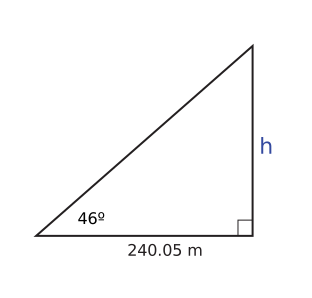
Total height of Tower B
Therefore, the height of Tower B is 398.58 m.

Self-check
Rate your level of understanding from 1 (I am still confused) to 5 (I fully understand this concept) based on your results from the questions you just completed.
I am able to:
If there are any criteria where you rated your level of understanding a 3 or below, you should review the concepts before moving on to the next learning activity.
Math journal

At the end of the course, you will fine-tune 8 entries (two from each unit) from your math journal and submit them as your “Culminating Assessment - Math journal” (Opens in new window).
Take pictures of two situations in the real world where you could use primary trigonometric ratios to solve. Include which measurements of the right triangle you know and which you would have to use calculations to solve.
One you feel comfortable with the success criteria, complete the following questions to assess your progress.
Assess your understanding
Notebook
For the following triangle, use your notebook to determine the value of . Round your answer to one decimal place. Check your answer with the suggested one provided.
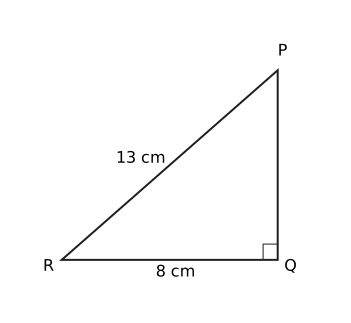
Since the length of the opposite side and the hypotenuse are given, use the sine ratio.
For the following triangle, use your notebook to determine the value of . Round your answer to one decimal place. Check your answer with the suggested one provided.
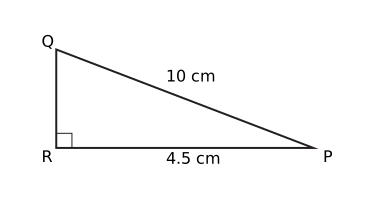
Since the length of the adjacent side and the hypotenuse are given, use the cosine ratio.
Find the length of the unknown side. Round your answer to one decimal place.
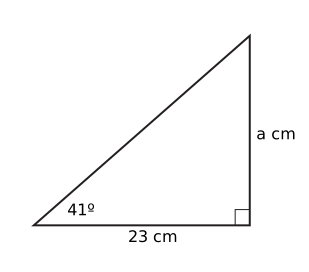
In relation to the 41° angle, is the opposite, and 23 cm is the adjacent. Use the tangent ratio.
For the following triangle, determine the value of . Round your answer to one decimal place. Check your answer with the suggested one provided.
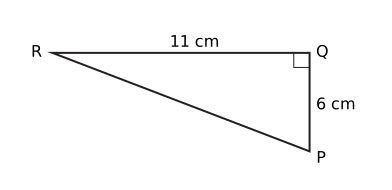
Since the length of the opposite side and the adjacent side are given, use the tangent ratio:
Find the length of the unknown side . Round your answer to one decimal place.
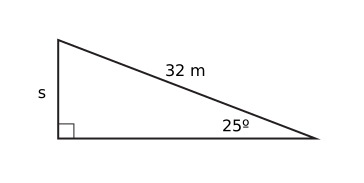
In relation to the 25° angle, is the opposite and 32 m is the hypotenuse.
Use the sine ratio.
Solve given that , , and .
Round answers to one decimal place.
What is angle ?
What is the length of side ?
Since and the opposite side cm, to find , which is adjacent , use the tangent ratio.
What is the length of side ?
There are a variety of ways to find the value using either the trigonometric ratios or the Pythagorean theorem.
Extend and connect your skills
1. An airport in Switzerland is located in a valley surrounded by mountains. A small aircraft takes off from a runway located near a mountain that is 1,500 m high. The mountain’s peak, located 2.7 km from the end of the runway, is on the flight path. What is the angle of ascent needed for the plane to clear the top of the mountain? Round your answer to the nearest degree.
Note that one length is given in metres and the other length is given in kilometres.
In order to work with the same units, convert 1,500 m to 1.5 km. (Recall that 1,000 m = 1 km, so 1,500 m = 1.5 km.)
Let represent the plane’s flight path. Let represent the height of the mountain. The plane’s angle of ascent is represented by as depicted in the following diagram.
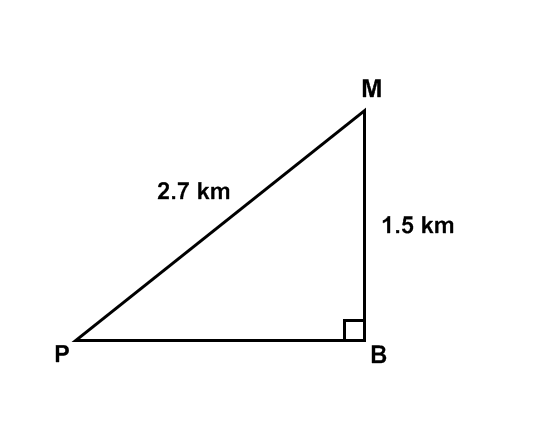
Since you know the length of the side opposite and you also know the hypotenuse, use the sine ratio to find .
Therefore, the plane’s angle of ascent should be .
2. A search-and-rescue helicopter flying at an altitude of 550 m identifies a fire at an angle of depression of . How far is the helicopter from the fire, to the nearest metre?
Let represent the helicopter and the distance from the ground to the helicopter. Let represent the fire. Let be a point directly above such that . The angle of depression is as depicted in the following diagram.
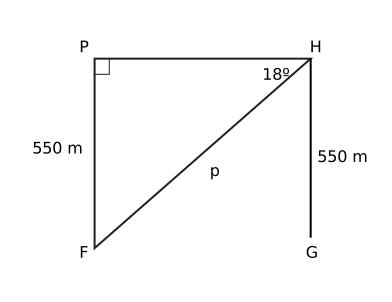
You are required to find the distance (or ). In relation to the known angle, is the opposite and is the hypotenuse. Use the sine ratio to solve the problem.
Therefore, the helicopter is 1,780 m from the fire.
3. A 19 m tall communication antenna is fastened to the ground by two wires, on opposite sides of the antenna. One wire makes an angle of with the ground while the other wire makes an angle of with the ground. Determine the following, correct to one decimal place.
- What is the length of each wire?
- What is the distance between the points where the wires are attached to the ground?
Let be the point where the wire that makes a angle is fastened to the ground. Let be the point where the wire that makes a angle is fastened to the ground. Let represent the antenna as depicted in the following diagram.
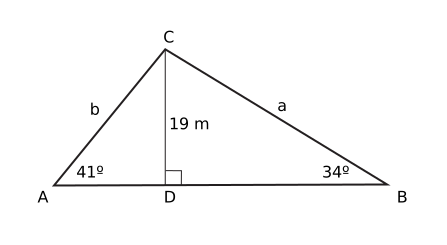
In ,
The wire that makes a angle with the ground is 29.0 m long.
In ,
The wire that makes a angle with the ground is 34.0 m long.
The distance between the points where the wires are fastened is
.
To determine , use the tan ratio in .
is 28.2 m.
To determine , use the tangent ratio in .
.
The distance between the points where the wires are fastened is 50.1 m.