
Acute triangles
The trigonometric ratios from the previous learning activity can only be applied to solve problems that involve right triangles. For situations that involve oblique triangle (a triangle that does not contain a right angle), different methods are required that involve a trigonometric equation traditionally called the sine law.
In this learning activity you will learn how the sine law is used to solve acute triangles. Begin by comparing acute triangles to obtuse triangles.
An acute triangle is a non-right triangle in which all three angles are less than 90°. The following are examples of acute triangles.
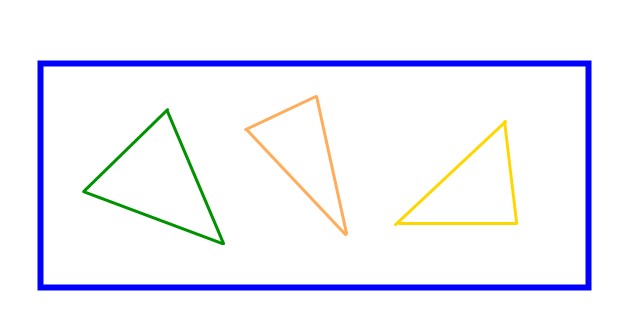
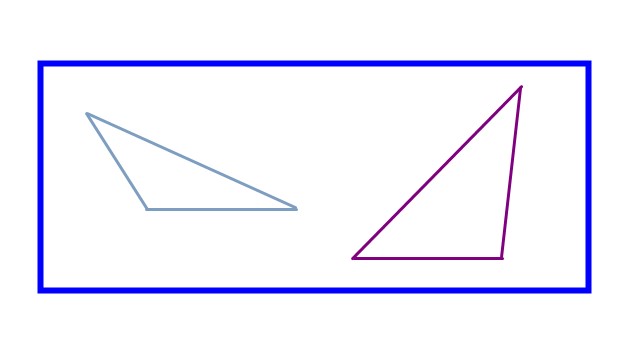
The following are not acute triangles. You will notice that in each triangle there is one angle that is larger than 90°. The following are examples of obtuse triangles.
History of Trigonometry
Trigonometry is derived from Greek words trigonon meaning “triangle” and metron meaning “to measure”. To learn more about the the historical concepts and importance of it’s applications explore the information below.

Investigating sine law
Investigation 1: Relating angle measures and side lengths
In this section, you’ll investigate relationships between the angles and side lengths of acute triangles. You are encouraged to follow the instructions and answer the related questions. The solutions to the investigations are provided so that you may assess your answers and table entries.
Try it!

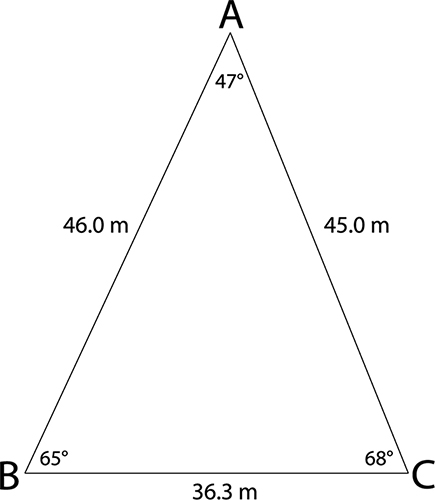
Consider the following triangle. Enter its angle measures and side lengths into a table like the one beside and check your answers.
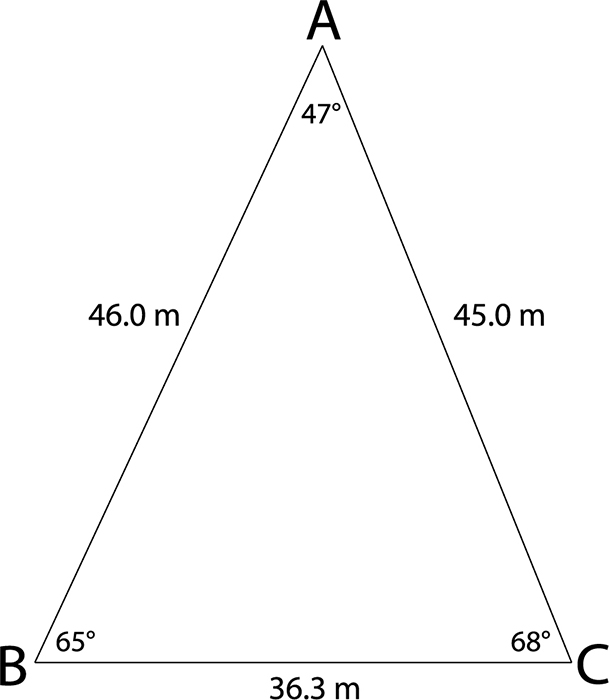
| Angle (degrees) | Side length (m) |
|---|---|
| A = | a = |
| B = | b = |
| C = | c = |
What relationship do you notice between the side length and the angle measure?
The bigger angle, the bigger the side length across from it.
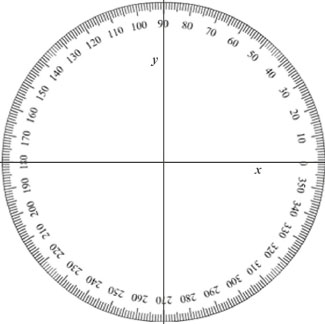
You might own a circular or semicircular protractor. A protractor is a device used to measure and draw angles. Beside is a protractor with .
Notebook

Draw your own acute triangle in your notebook. Label the vertices (or angles) , , and . Use a ruler to measure each side to the nearest centimetre. Use a protractor to measure the angles to the nearest degree.
| Angle (degrees) | Side length (m) |
|---|---|
Explore this!

If you need to refresh yourself on how to measure angles.
Think

Does the relationship you described for the previous table also hold true for triangle ABC?
Yes, the larger the angle, the larger the side length opposite that angle.
Create a conjecture (a hypothesis or prediction) about the positions of the largest angle and the smallest angle in a triangle as related to the side lengths.
One of the student’s response is: “The shortest side is opposite the smallest angle. The next shortest side is opposite the next smallest angle. The longest side is opposite the largest angle. The same holds true for .”
Investigation 2: Comparing sine ratios and side length ratios
Use the angles and side lengths of to complete a table like the following.
| Sine ratios | Side length ratios | ||
|---|---|---|---|
Think
What relationship do you notice between the ratios in the first column and the ratios in the second column?
The ratios of side lengths are equal to the ratios of the sine of the corresponding angles. Small differences are due to rounding of measurements on the diagram.
Create a conjecture about the relationship between the sine ratios (in the first column) and the corresponding side length ratios (in the second column).
Conjecture: The ratio of the sine of the angles equals the ratio of the sides opposite the angles. The same holds true for any triangle.
In general,
, ,
Investigation 3: Comparing ratios of sine and side lengths
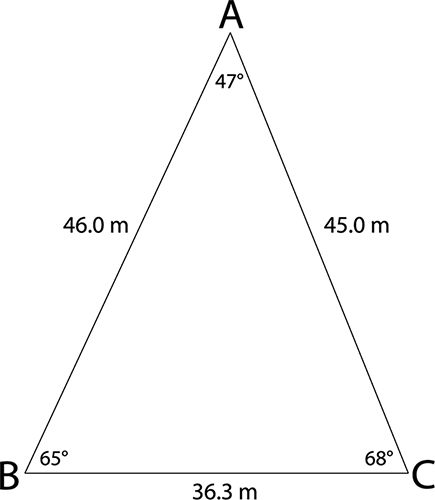
Use the angles and side lengths of to complete a table like the following.
| Sine vs side ratios | Side vs sine ratios | ||
|---|---|---|---|
Think
What relationship do you notice between the ratios in the first column?
The ratios in the first column are equal. Any small differences that you notice are due to rounding of measurements on the diagram.
What relationship do you notice between the ratios in the second column?
The ratios in the second column are equal. Any small differences that you notice are due to rounding of measurements on the diagram.
Consider a conjecture about the relationship between the ratios in the first column.
Conjecture: The ratios in the first column are equal.
Consider a conjecture about the relationship between the ratios in the second column.
Conjecture: The ratios in the second column are equal.
How are the two columns related?
Conjecture: The ratios in the second column are the reciprocals of the ratios in the first column.
In general,
or
The sine law
For any triangle ,
or
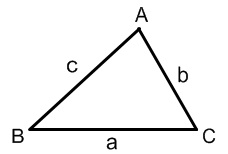
You can use the sine law when the measure of one angle and the length of its opposite side are known in an acute triangle. If two angles and the contained side (the side between the two angles) are known, then first find the third angle and then the sine law may be used.
Using sine law to solve triangles
Think
The following exercise demonstrates how to use the sine law to find the length of unknown sides.
1. Determine the length of the indicated sides ( and ) and unknown angle for the triangle beside. Round to one decimal place.
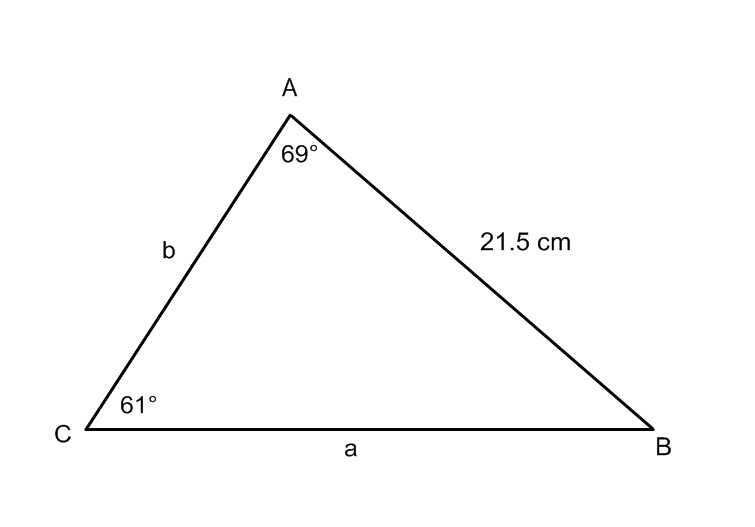
the following exercise demonstrates how to use the sine law to find the measure of an unknown angle.
In , , , and . Determine the measures of and and round to one decimal place.
First, draw a diagram of the triangle, similar to the following, labelling the known quantities.
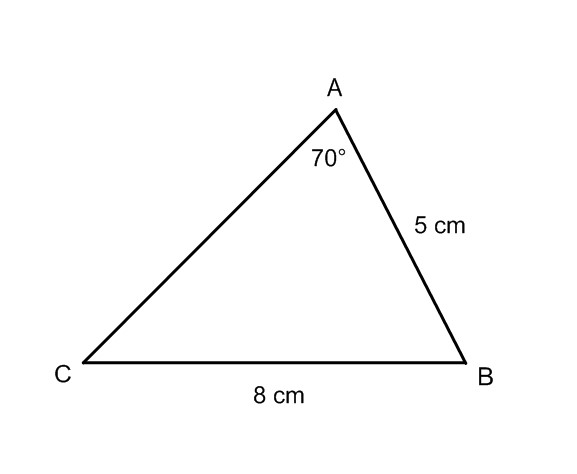
Therefore, is .
You need to find first.
Therefore, .
3. In , , , and . Determine the length of the altitude(the height of the triangle) from to . Draw a diagram as your first step.
Draw the diagram similar to the following and label the given information:
- Note that in a triangle, the altitude is the height and so intersects at a angle. Therefore, the altitude from to intersects at a angle.
- Draw the altitude from to .
- Let be the point of intersection of the altitude from to .
- Let represent the length of the altitude.
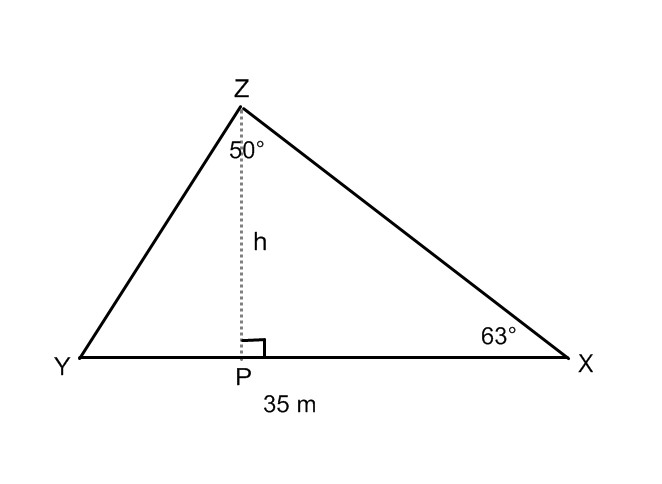
Therefore .
Let and ,
Find the length of using the sine law in .
You know and the opposite side .
therefore
Solve for y.
The length of is
The value of can be determined by using the right triangle .
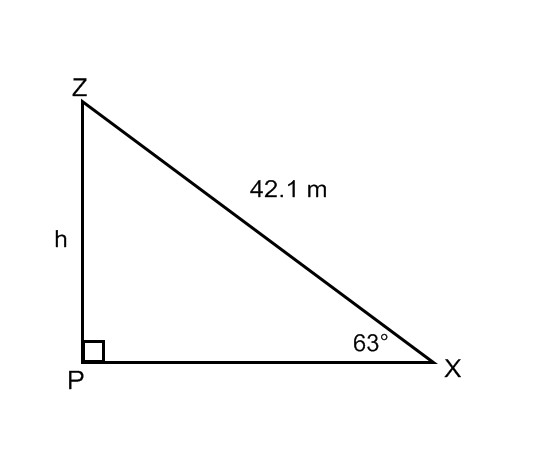
As you learned in Learning Activity 4.1, you can solve for unknown lengths of right triangles when given another side length and an angle by using the primary trigonometric ratios.
The length of the altitude is .
Applications of sine law
It is important to notice that the sine law is used when the degree measure of an angle and the length of its opposite side are known. Sometimes two angles and the contained side (side between the two angles) are given. In this case, the third angle must be found first and then the sine law can be applied.
Notebook
You can use your notebook to complete each of the following questions using sine law. Compare your work with the suggested answers to check your understanding.
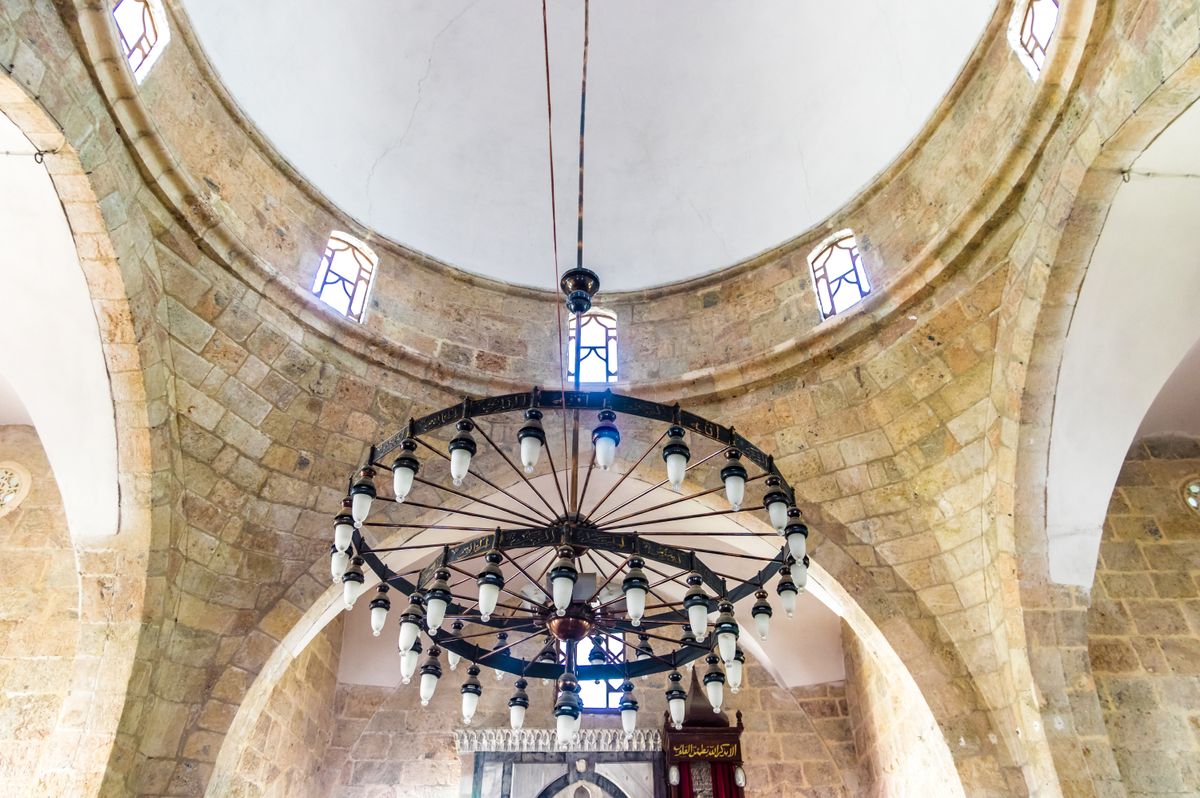
1. A chandelier is suspended from the ceiling by two chains.
One chain is long and forms an angle of with the ceiling. The other chain is long. Determine the measure of the angle that the chain makes with the ceiling. Round your answer to two decimal places.
Let and represent the points in the ceiling where the chains are attached. Let represent the chandelier as depicted in the following diagram.
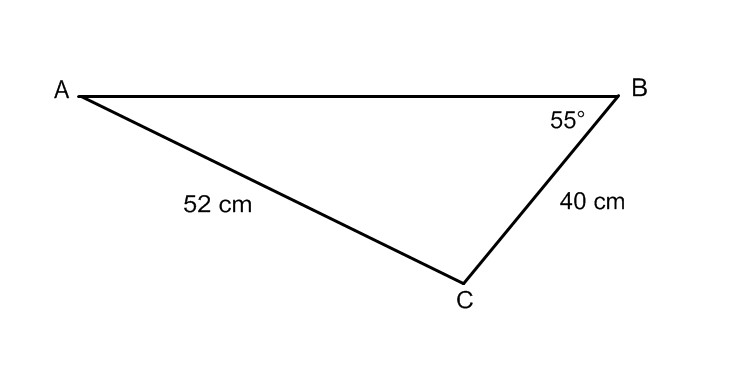
You are required to find .
Therefore, the chain makes an angle of with the ceiling.
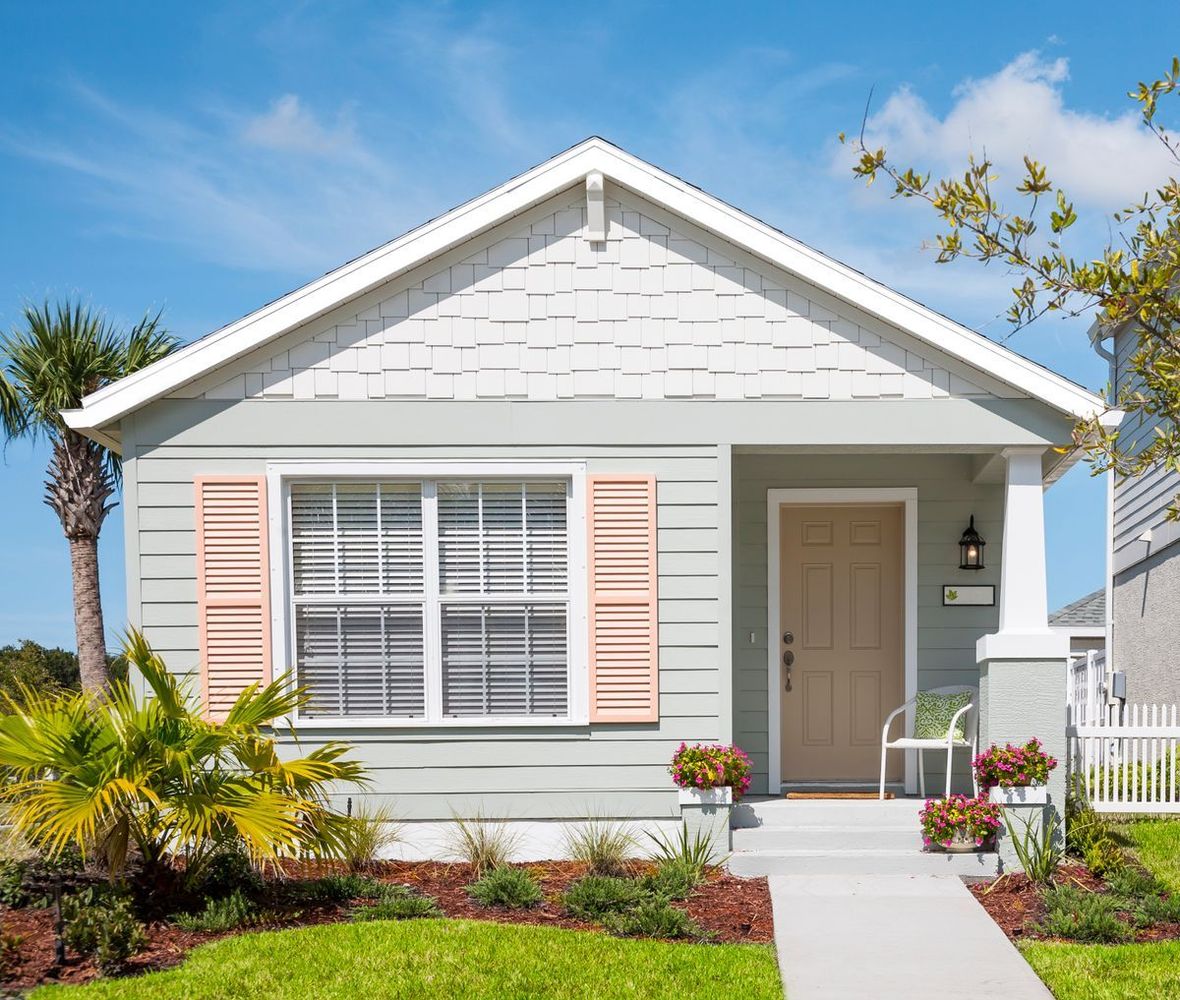
This exercise illustrates the application of the sine law in a construction problem.
2. An architect designs a cottage that is wide. The rafters holding up the roof meet at a angle and are equal in length. The rafters extend beyond the two exterior supporting walls. Determine the length of the rafters to one decimal place. Check your diagram and following solution.
Since the two rafters are equal in length, then is isosceles and so .
Label each of the . The length of each rafter is .
It is also true that . Label each of the .
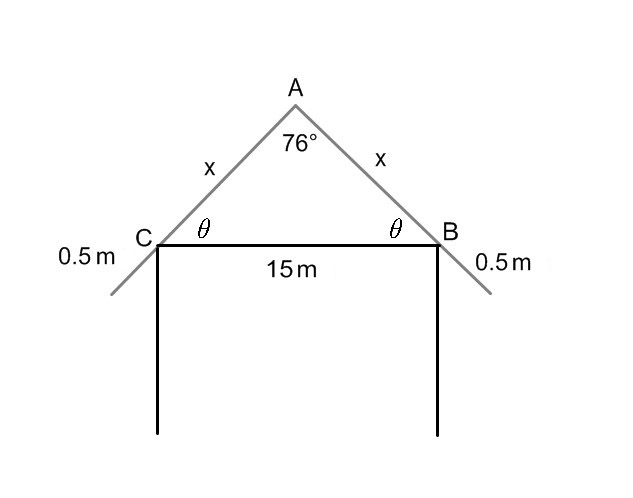
Length of the beam
Length of the beam
Length of the beam
Therefore, the length of each rafter is .
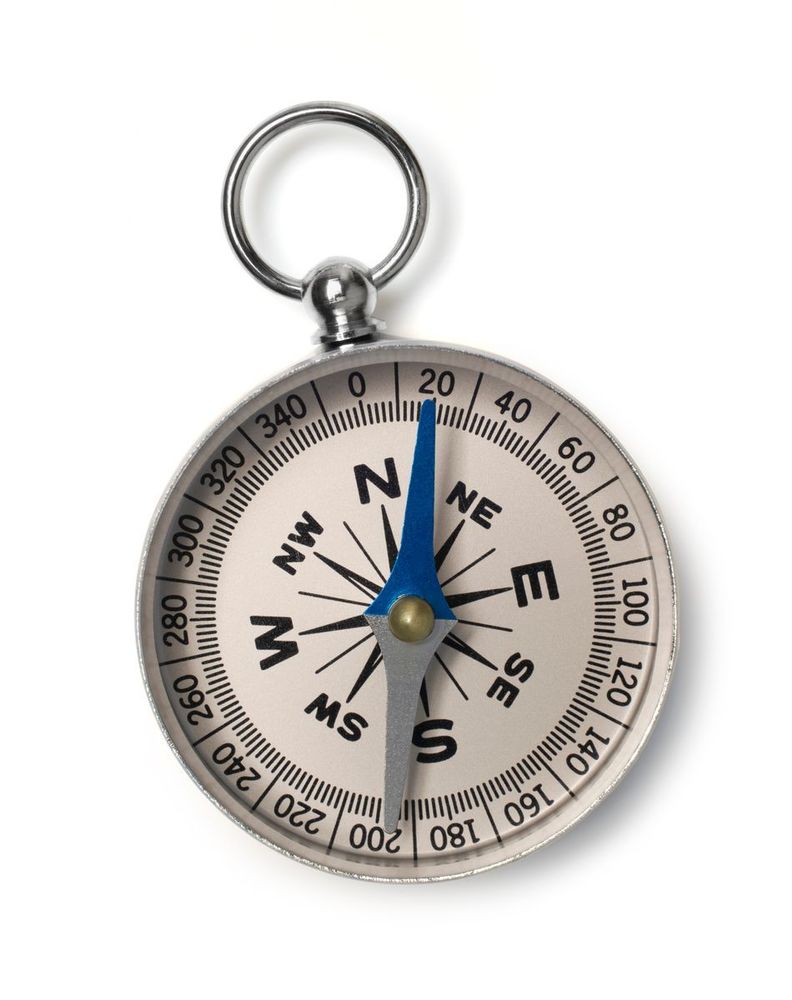
The following exercise involves the use of compass measurements.
3. A sightseeing yacht leaves a mainland dock and sails to an island located at a point located N 15° W off the mainland. It remains there for two days and then sails to a second island located S 40° W of the first island. If the second island is from the mainland, how far apart are the two islands?
Sketch of the path of the yacht. From the mainland, point M, it travels N 15° W.
It stops at the first island, point A.
From point A it travels S 40° W to the second island.
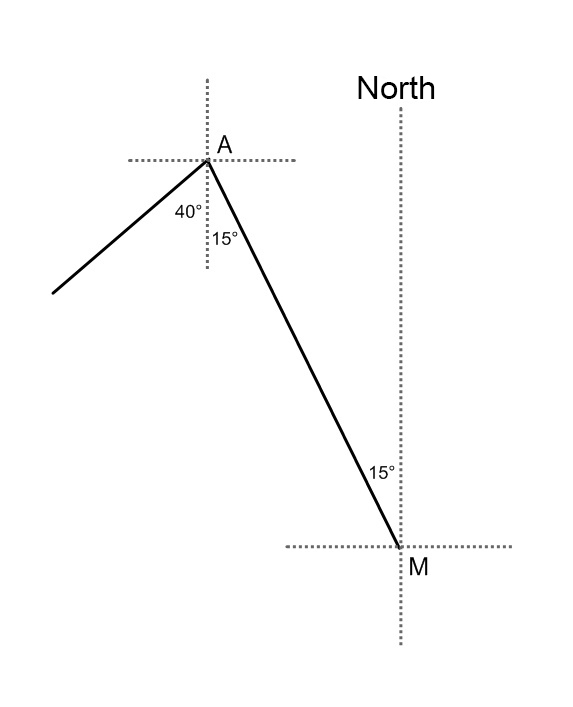
As shown, .
Let represent .
Let represent .
Add this information to your diagram as depicted in the following:
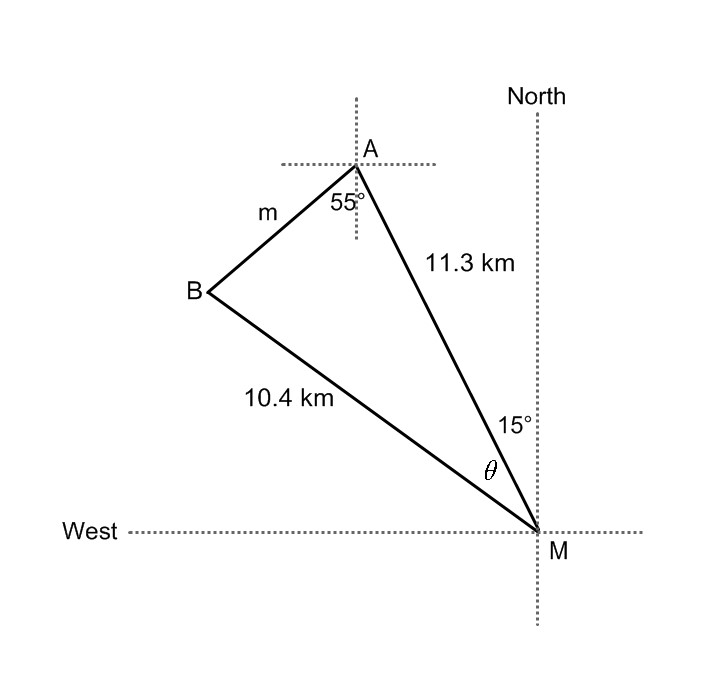
Therefore, .
Therefore, .
Solving for m, which is the distance between the two islands:
Therefore, the distance between the two islands is .

Self-check
Rate your level of understanding from 1 (I am still confused) to 5 (I fully understand this concept) based on your results from the questions you just completed.
I am able to:
If there are any criteria where you rated your level of understanding a 3 or below, you should review the concepts before moving on to the next learning activity.
Math journal

At the end of the course, you will fine-tune 8 entries (two from each unit) from your math journal and submit them as your “Culminating Assessment - Math journal”(Opens in new window).
Compare when to use Pythagorean theorem, primary trigonometric ratios, and sine law. You can use a chart like the following one or create a mind map like in Learning activity 1.5.
| Pythagorean theorem | Primary trigonometric ratios | sine law | |
|---|---|---|---|
| Equation(s) | |||
| When do we use it? | |||
| Example of triangle |
Once you feel comfortable with the success criteria, complete the following questions to assess your progress.
Assess your understanding of the sine law
The following are some questions for you to try in order to assess your understanding of the sine law.
Try it!
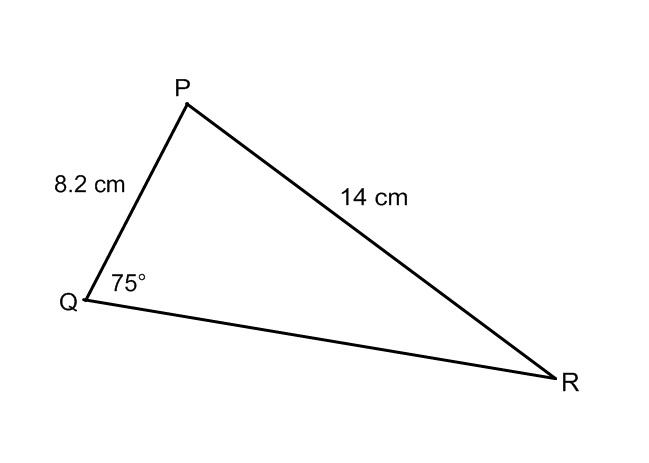
Solve the following triangle. Round your answers to one decimal place.
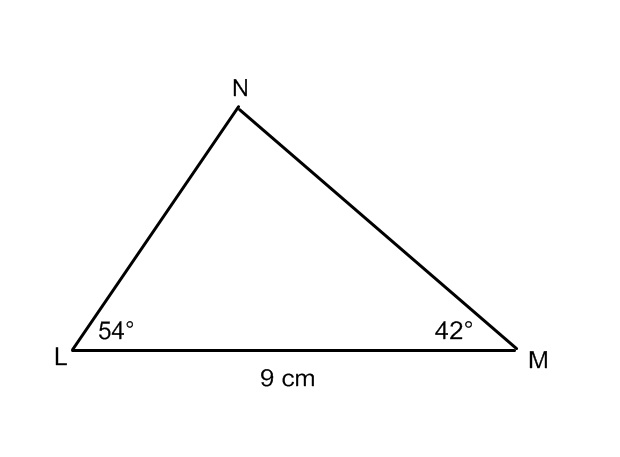
Solve the following triangle. Round your answers to one decimal place.
Determine the area of given that , , and . Round your answer to one decimal place.
Draw the diagram and label the given information:
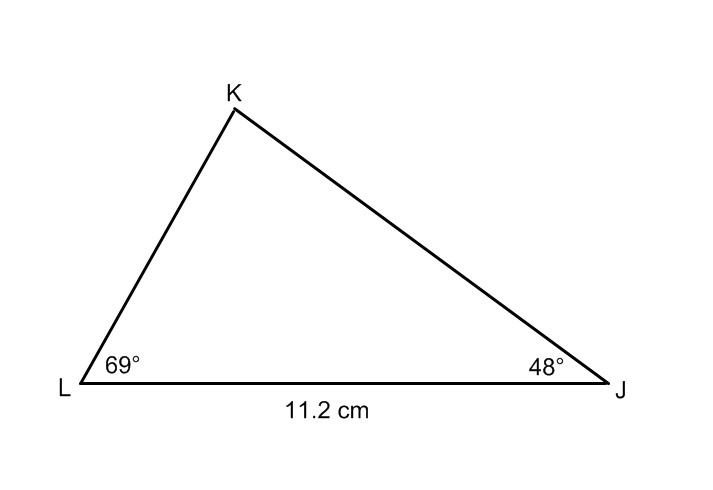
Recall that the equation for the area of a triangle is
as the base of the triangle.
Draw height from to a point on line . Call this point .
Let represent .
=
=
Therefore .
The height of the triangle is .
Therefore, the area of the triangle is .
Assess your understanding of solving real-world problems
The following questions will help you assess your understanding of solving real-world problems.
Try it!
Be sure to try the questions on your own first before comparing them to the suggested answers.
1. A farmer’s field is in the shape of a triangle.
One side of the field is located along a river and measures 720 m. The other two sides are fenced and make angles of 45° and 55° with the river. Determine the area of the field.
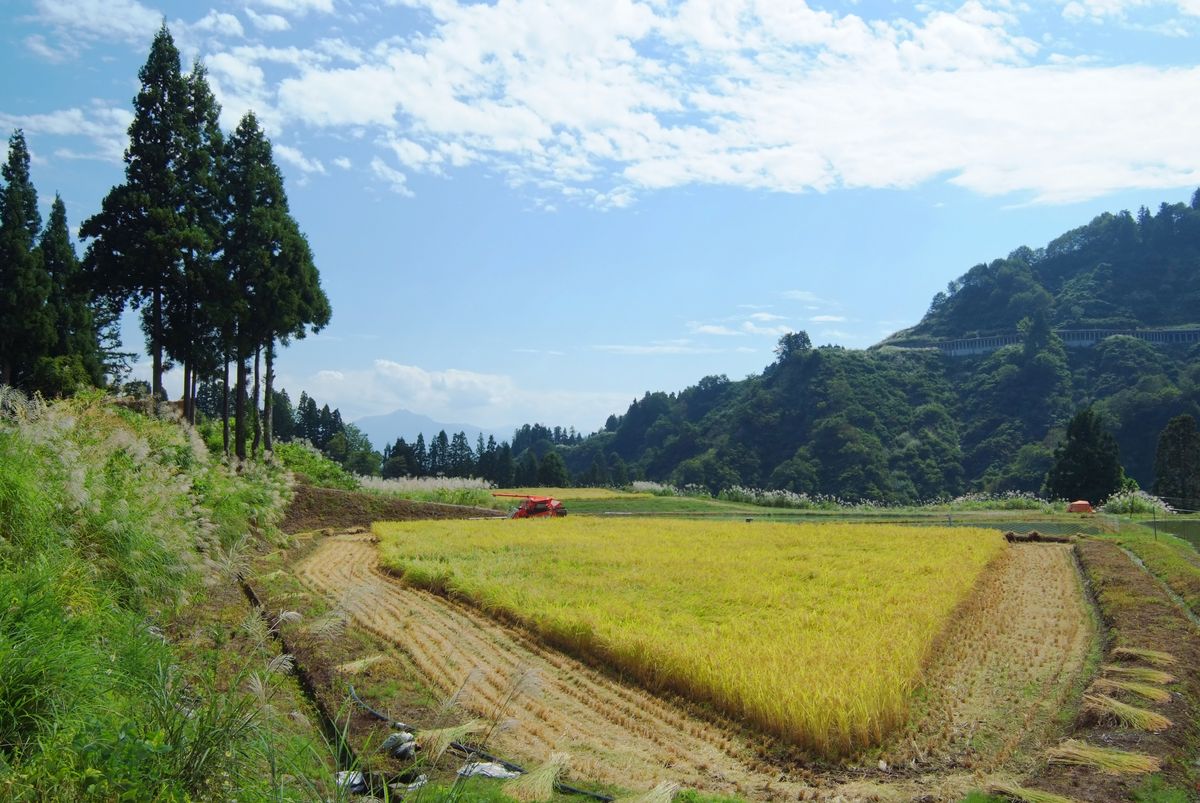
Consider that the area of a triangle is found using the formula
Use as the base of the triangle.
Draw the height from to . Call this point as depicted in the following diagram.
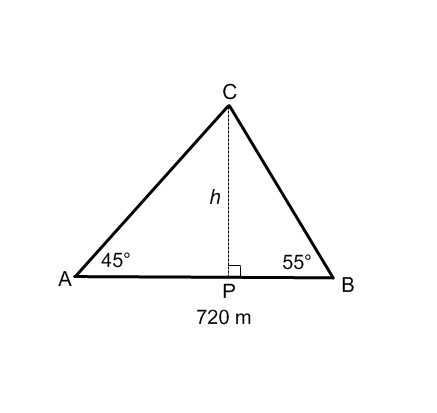
To determine the length of , first use the sine law to find the length of .
Therefore, is .
Therefore, the height of the triangle is .
Therefore, the area of the rice field is .
2. A traffic light is suspended above a road with two cables, each attached to a horizontal metal beam. One cable is long and forms an angle of with the metal beam. The other cable is long. Determine the measure of the angle that the cable makes with the beam. Round your answer to one decimal place.
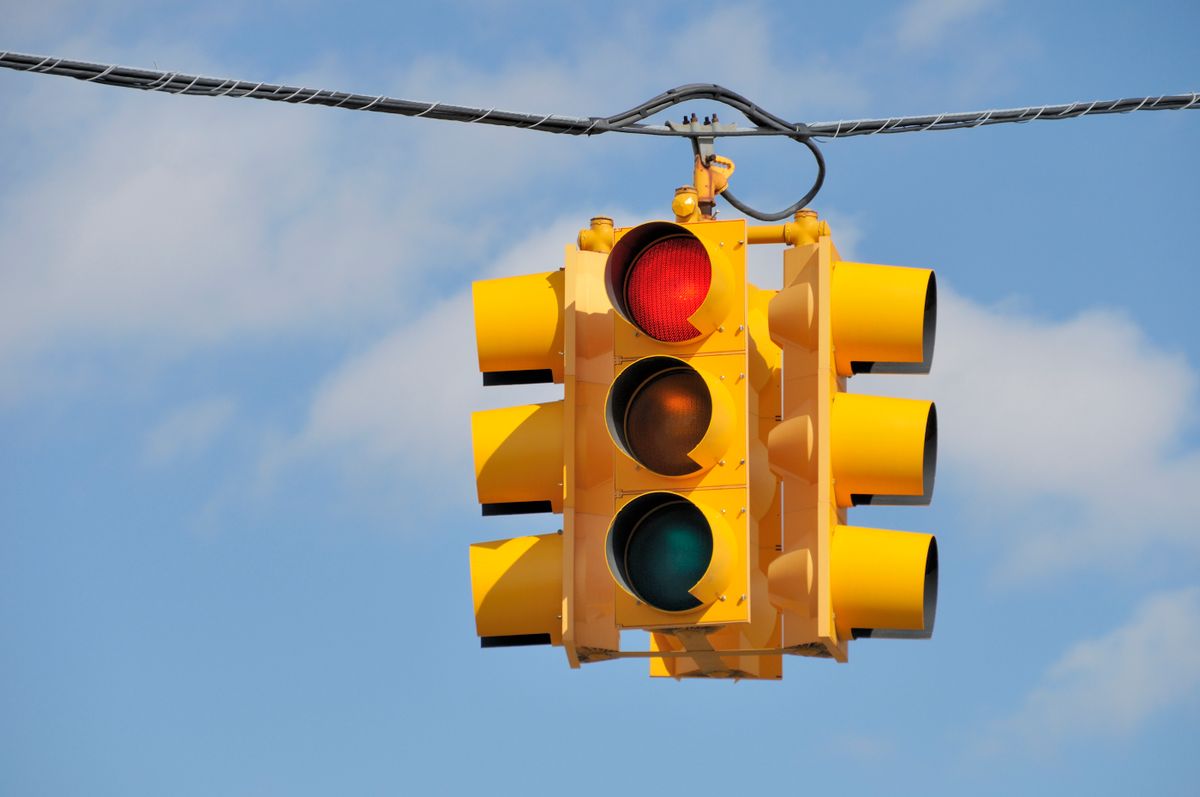
Let and represent the points on the metal beam where the cables are attached.
Let represent the traffic light.
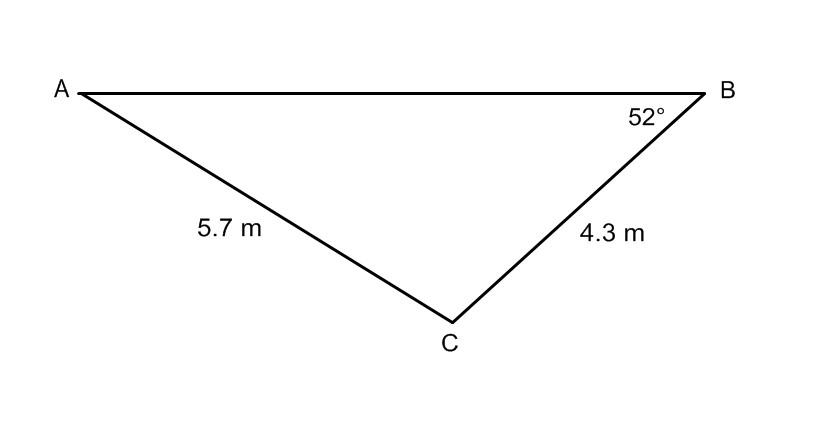
Since you know the measure of B and the length of its opposite side, use the sine law.
=
=
Therefore, the cable makes an angle of with the metal beam.