
In this learning activity, you will learn about the cosine law and under what circumstances you will use it. You will also learn to solve real-life problems of triangles using cosine law.
Join the discussion

Using a search engine of your choice research:
- What are the Law of Sines and Law of Cosines?
- Why use them?
- Find a profession which uses the Law of Sines and Law of Cosines?
Press the “Join The Discussion” button when you’re ready to engage.

(opens in a new window)

Investigating cosine law
There are some situations for solving triangles in which you are only given two side lengths and the contained angle (the angle formed by these sides). There are other situations where all three sides of the acute triangle are known while no angles are known. You will learn to apply the cosine law in these cases. You will begin by developing the cosine law.
Example
Consider the following problem. Andrew, Basheer, and Colin are friends. Their residences are situated such that Andrew’s house is 8 km from Basheer’s house and 5 km from Colin’s house. If the angle between the roads from Andrew’s house to Basheer’s house and Colin’s house is , how far is Colin’s house from Basheer’s house?
To solve this problem, first draw a diagram to represent the situation. Let points , , and represent Andrew’s house, Basheer’s house, and Colin’s house. The length of is , the length of is , and When two sides and the contained angle are known.
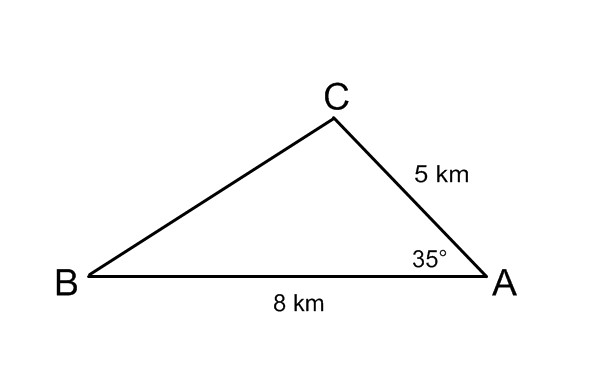
In the triangle we have just examined, the lengths of two sides and the contained angle are known. You don’t know the length of the opposite side of the given angle; therefore, the sine law cannot be used to solve this problem. Since the triangle is not a right triangle, the trigonometric ratios cannot be applied to solve this problem.
When two sides and the contained angle are known
It is clear that a new method is required to solve this problem. You will develop this new method by constructing a perpendicular, thus creating a right triangle. Then you can use the trigonometric ratios.
Construct altitude that is perpendicular to .
Let , , and . Since , and , then as depicted in the following diagram.
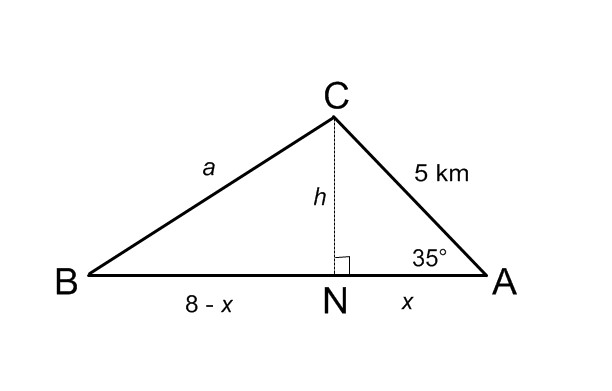
As you can notice, the solution is quite long and requires constructing an altitude to divide the larger triangle into two right triangles. Fortunately, there is a shorter method, similar to the sine law, which can then be used to solve triangles with two given lengths and the contained angle.
Apply the steps used in the previous solution to develop the cosine law for the triangle .
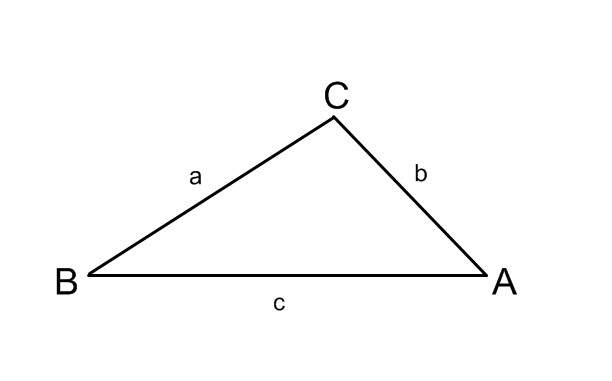
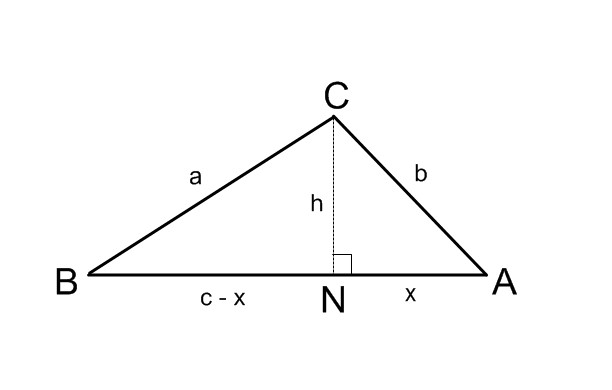
Construct altitude that is perpendicular to .
Let , , and .
Since , and , then .
Summary
The cosine law
For shown here, the cosine law is as follows:
Note the following pattern in each equation when detailing the cosine law:
- is the side across from angle
- is the side across from angle
- is the side across from angle
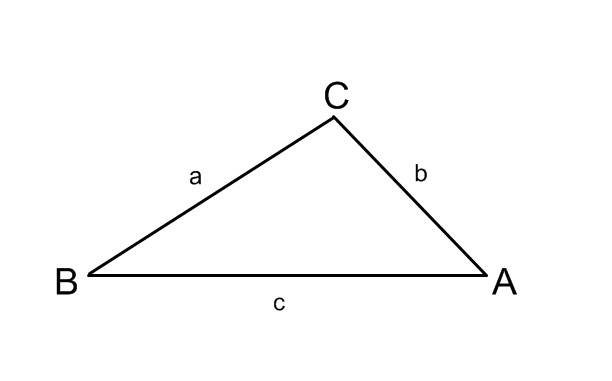
It is not necessary to know all three equations, as each equation represents the cosine law for one particular side of the triangle. All you need to do is use your knowledge to understand the pattern.
The cosine law is used to:
- find the third side in a triangle when two sides and the contained angle are known
- find one angle in a triangle when all three side lengths are known.
Interestingly, the cosine law is an extension of the Pythagorean theorem. Imagine for a moment that is a right angle. You know that , which means that if is , then
becomes
Solving acute triangles using cosine law
In this section, you’ll apply the cosine law to some problems. With a little practice, you’ll be able to solve acute triangles this way.
Explore this!

Explore the following video to understand how to use cosine formula to determine the unknown side of a triangle when two sides and a contained angle are known.
When side lengths only are given:
In some problems that involve acute triangles, as in , all three side lengths may be known as depicted in the following diagram.
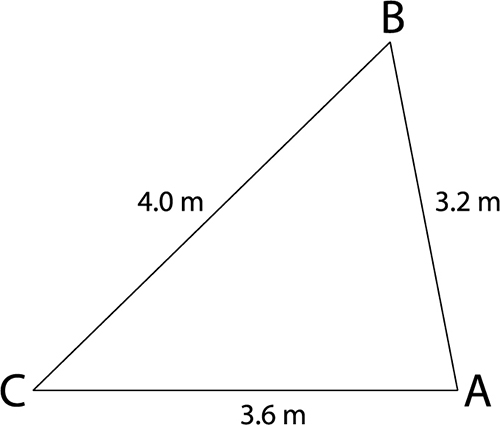
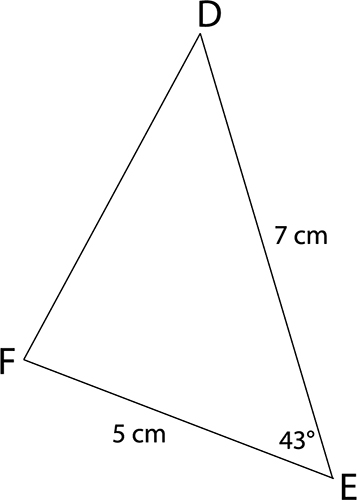
In other problems that involve acute triangles, two side lengths and the contained angle may be known, as in as shown in the following diagram.
Notebook

You can use your notebook to complete each of the following questions. Compare your work with the suggested answers to check your understanding.
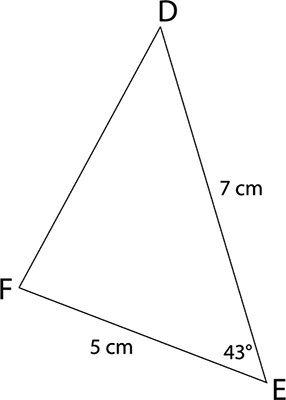
- Solve for the unknown side, correct to one decimal place.
The unknown side is across from . Represent the cosine law to correspond with the letters in the triangle.
Therefore, .
In the following exercise, the cosine law is required to obtain the smallest angle first. Once this angle is found, the sine law can be used to determine other unknown measures.
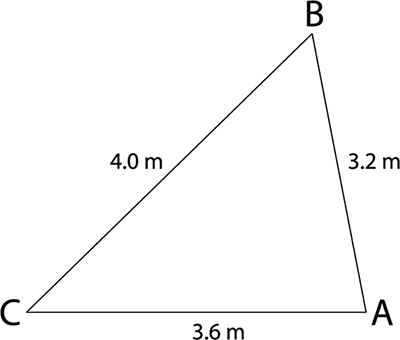
- Determine the degree measure of the smallest angle.
The smallest angle is found across from the shortest side. Since is the shortest side then is the smallest angle.
Therefore, the smallest angle is .
- Determine the remaining unknown measures.
We can use sine law to solve for this. Review Learning Activity 4.2 on sine law if necessary.
Therefore .
Therefore .
In the following exercise, two sides and a contained angle are known. In other words, you are not given the length of the opposite side.
- Solve triangle , given that , , and . Round your answers to one decimal place.
Your diagram should resemble the following:
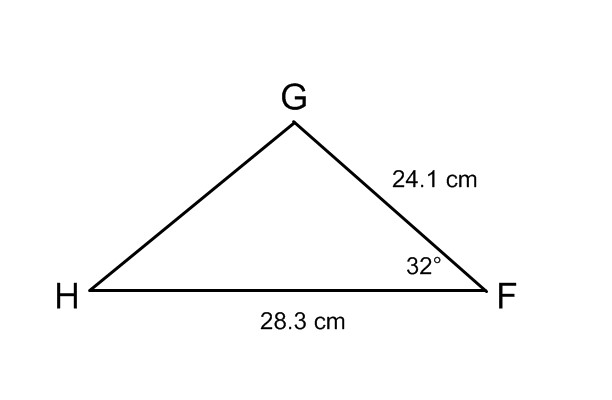
Therefore, .
Therefore, is .
Therefore, .
Applications involving cosine law and sine law
In the following, you’ll learn to solve a variety of real-world application problems that involve not only the cosine law but also a combination of both the cosine law and the sine law.
Often the cosine law is used first to determine an unknown side and then the sine law can be used to continue to solve the problem. In each situation, it is important to draw an accurate diagram to represent the situation. The given information may be used to determine other required values that are not directly given in the problem.
You’ll explore this process in the exercise that follows.
Notebook
You can use your notebook to complete each of the following questions. Compare your work with the suggested answers to check your understanding.
Two or three side lengths given
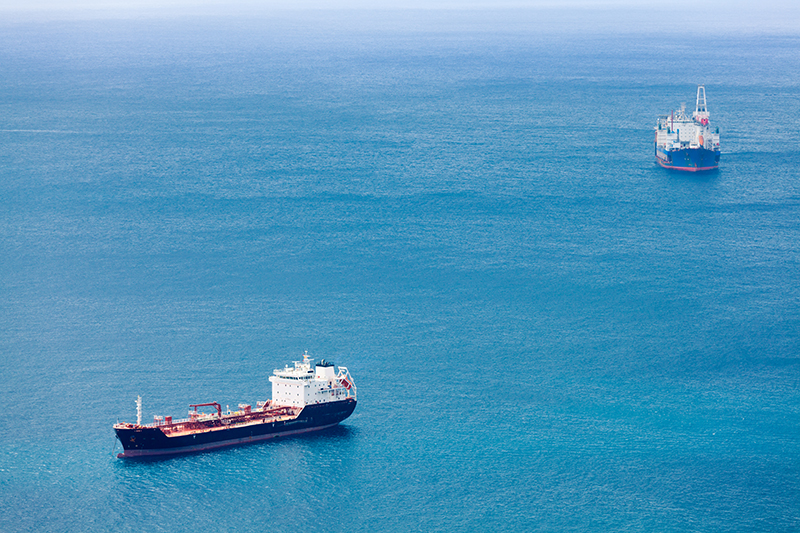
- A radar station is tracking two ships, the Sierra and the Meribleu.
The Sierra is located at a point N 35° E from the radar station at a distance of 4.5 km. The Meribleu is 3.3 km from the radar station at a point that is S 48° E, given this information, solve for how far apart the two ships are from each other.
Draw the diagram in terms of north, south, east, and west.
Let represent the radar station.
Let represent the Sierra.
Let represent the Meribleu.
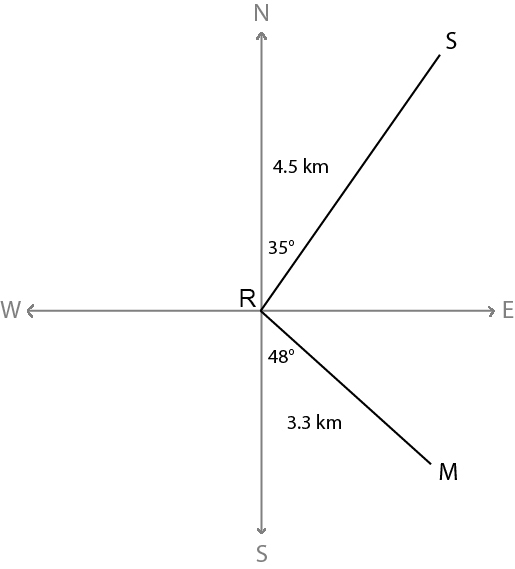
To solve the problem, use the triangle formed by the points , , and .
Since is , then
Since is , then
Updating the following diagram:
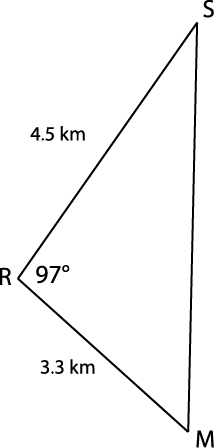
Since you know the measure of two sides and the contained angle, use the cosine law to determine the distance between the two ships:
Therefore, the ships are approximately apart.
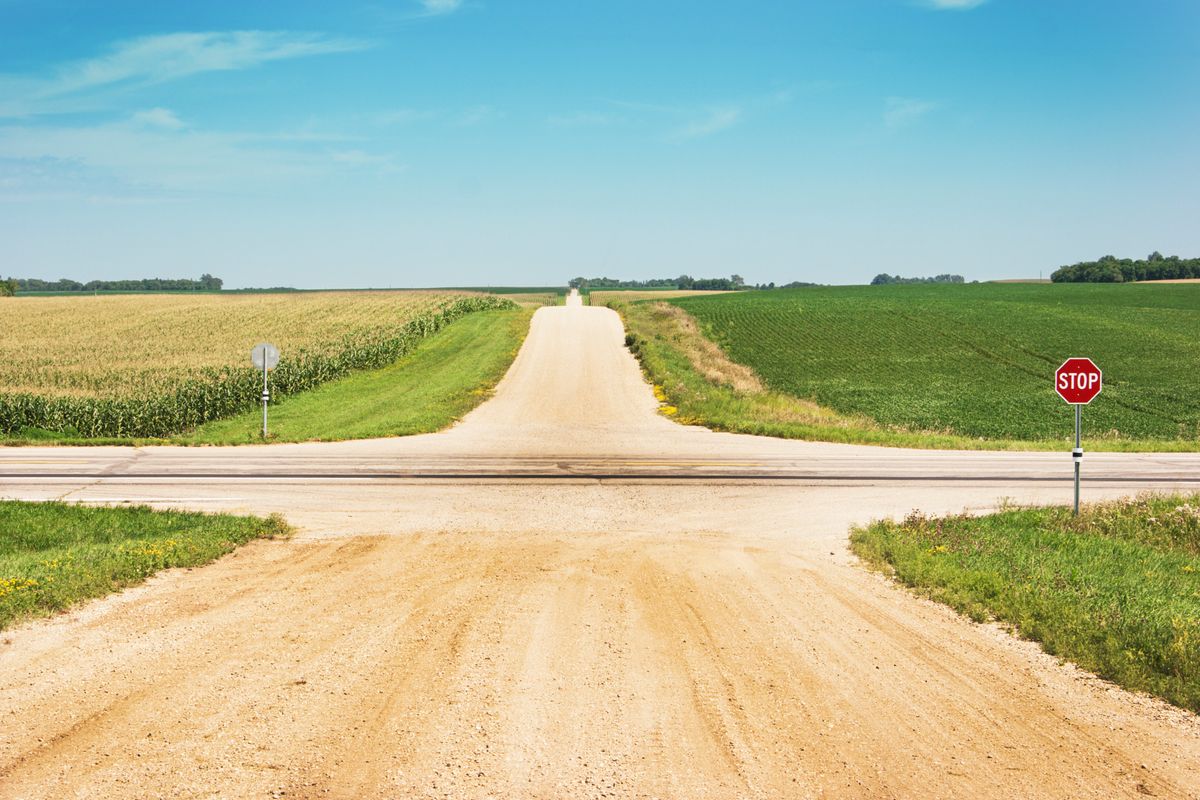
- Two bike riders are travelling along two separate country roads that cross at a four-way stop.
They arrive at the intersection of the two perfectly straight roads at the same time. They stop for a moment and then leave the intersection on two different roads at the same time. One bike rider is travelling at 17 km/h and the other is travelling at 24 km/h. After three hours of biking, they stop and it is observed on their GPS maps that they are now 61 km apart. Your task is to find the angle formed by their two roads at the crossroads. To find the angle at which the crossroads meet, answer the following series of questions. Note that you will be finding the measure of the acute angle.
The slower bike rider is travelling at 17 km/h. In three hours, she has travelled a distance of
.
The slower bike rider has travelled 51 km in the three hours.
The faster bike rider is travelling at 24 km/h. In three hours, he has travelled a distance of
.
The faster bike rider has travelled 72 km in the three hours.
Let represent the intersection of the two roads.
Let represent the position, after three hours, of the slower bike rider.
Let represent the position, after three hours, of the faster bike rider.
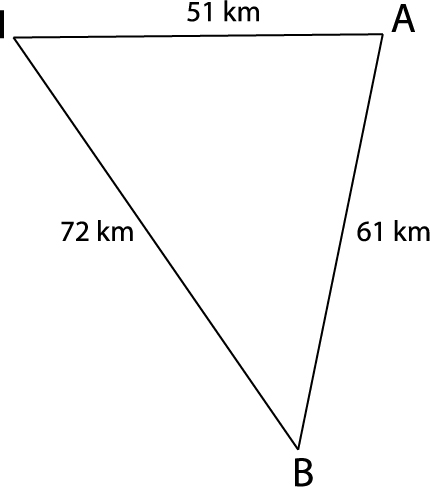
Therefore, at their intersection, the two roads diverge at an angle of .
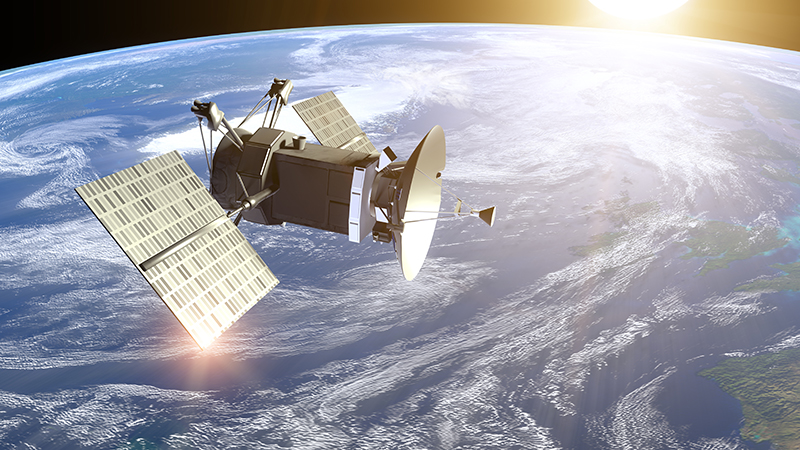
- A line of sight drawn from a satellite, positioned in space between Ottawa and Toronto, makes an angle of with the ground at Ottawa.
The satellite is 600 km from Ottawa, and the distance from Ottawa to Toronto is 350 km in a straight line.
Determine, to one decimal place, the distance from the satellite to Toronto.
Let represent the satellite.
Let represent Toronto.
Let represent Ottawa.
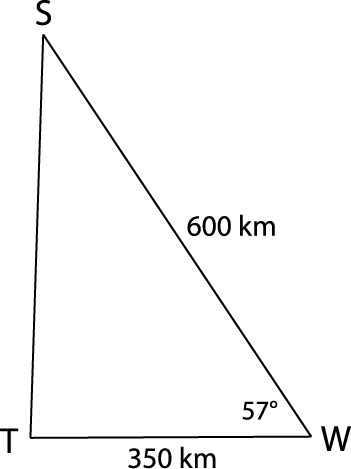
Therefore, the satellite is approximately 503.8 km from Toronto.
- Determine, to one decimal place, the angle the satellite’s line of sight makes with the ground at Toronto.
Updating the diagram, you have something similar to the following:
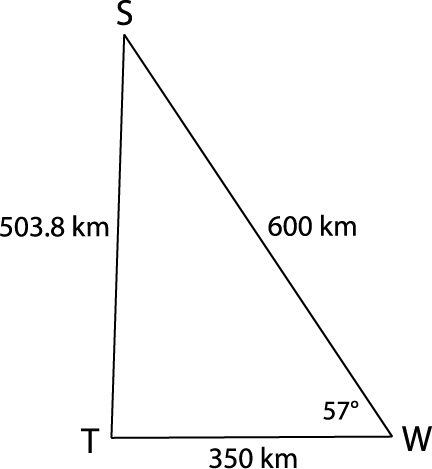
Therefore, the satellite’s line of sight makes an angle of with the ground at Toronto.
One can find the area of a triangular figure by combining both sine and cosine law.
- There is a triangular backyard with side lengths of 27 m, 21 m, 18 m. A bag of fertilizer covers 400 m2. Is there enough fertilizer to cover the entire backyard?
We know that the area of a triangle is given by:
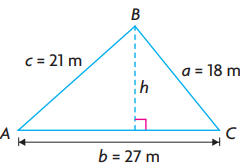
Here the longest side 27 m is taken as the base of the triangle and h is height of the triangle.
Since all three sides of the triangle are given, we use cosine law.

Self-check
Rate your level of understanding from 1 (I am still confused) to 5 (I fully understand this concept) based on your results from the questions you just completed.
I am able to:
If there are any criteria where you rated your level of understanding a 3 or below, you should review the concepts before moving on to the next learning activity.
Math journal

At the end of the course, you will fine-tune 8 entries (two from each unit) from your math journal and submit them as your “Culminating Assessment - Math journal” (Opens in new window).
Add to the summary you made in the last activity, but add cosine law and where you would need to use these in the real world. Your summary may resemble the one below. It may also be helpful to create this into a mind map like the one created in Learning Activity 1.4
| Pythagorean theorem | Primary trigonometric ratios | Sine law | Cosine law | |
|---|---|---|---|---|
| Equation(s) | ||||
| When do we use it? | ||||
| Example or triangle | ||||
| Real-world application |
Also, compare and contrast the sine law and cosine law. Make sure to include when to use each with an example.
Once you feel comfortable with the success criteria, complete the following questions to assess your progress.
Assess your understanding: When two angles and one side is known
Notebook
You can use your notebook to complete each of the following questions. Compare your work with the suggested answers to check your understanding.
Solve the following given each set of data for .
- Solve for given triangle with: , , and .
Your diagram should resemble the following:
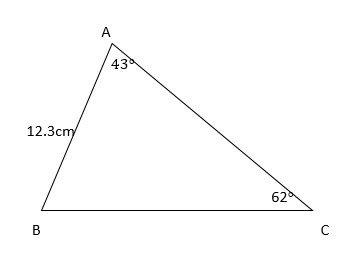
Since the measure of one angle and the length of its opposite side is known, the sine law is required to solve for .
Therefore, is .
- Solve for given , , and .
Your diagram should resemble the following:
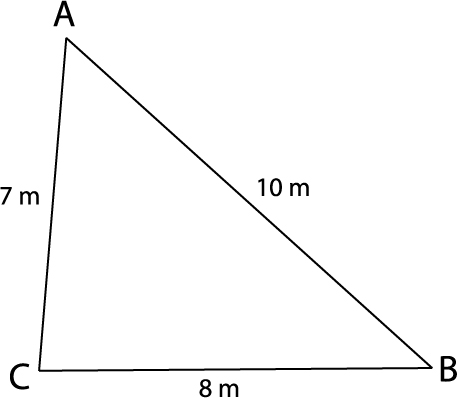
Since all three side lengths are known, the cosine law is required to solve for .
Therefore, .
- Solve given , , and .
Your diagram should resemble the following
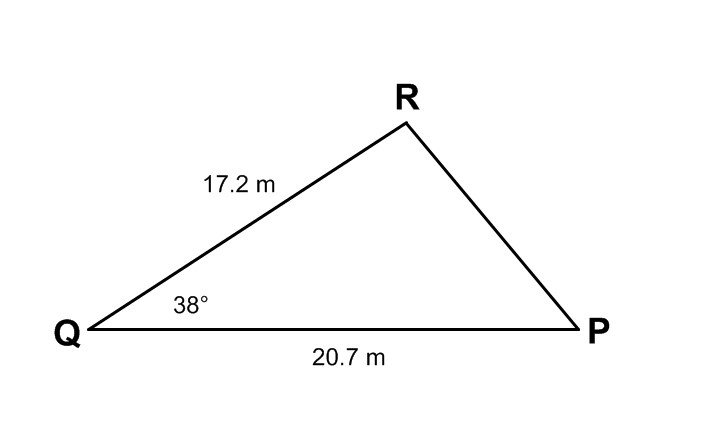
Use the cosine law to solve for :
Therefore, .
Use the sine law to determine :
Therefore, .
Therefore, .
Assess your understanding: When solving a problem involving an acute triangle
- When solving a problem involving an acute triangle, how do you know when to use:
The sine law?
Use the sine law when an angle and the length of its opposite side are known in an acute triangle. If only two angles and one side length are given (and the side length is not opposite any one of the two given angles), then find the third angle using the sum of the angles in a triangle before using the sine law.
The cosine law?
Use the cosine law in the following two situations:
- all three side lengths are known, or
- two angles and the contained side length are known
- Solve given that , , and . Round your answers to the nearest metre.
Your diagram should resemble the following:
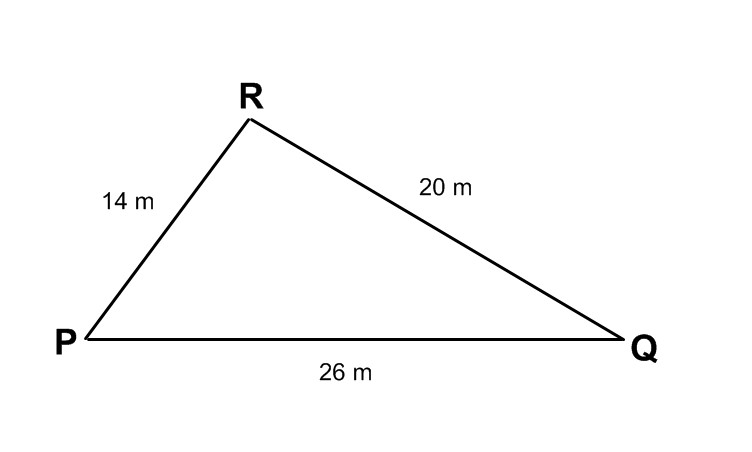
As you can notice, to solve this triangle, you’ll need to find the three angle measures.
Therefore, .
Therefore .
Therefore, .
- A sailboat in a race starts at point and sails E 21° S for 10.3 km to a red buoy. From there it sails S 38° W for 25 km to a blue buoy.
How far is the blue buoy from the starting point?
Let represent the starting point for the race.
Let represent the red buoy and let represent the blue buoy.
At point , draw a small set of compass directions to help you find the angle measures related to the given directions.
Be sure to indicate all the known measures. Also indicate other measures that can be found using parallel lines and complementary angles (angles that add up to ).
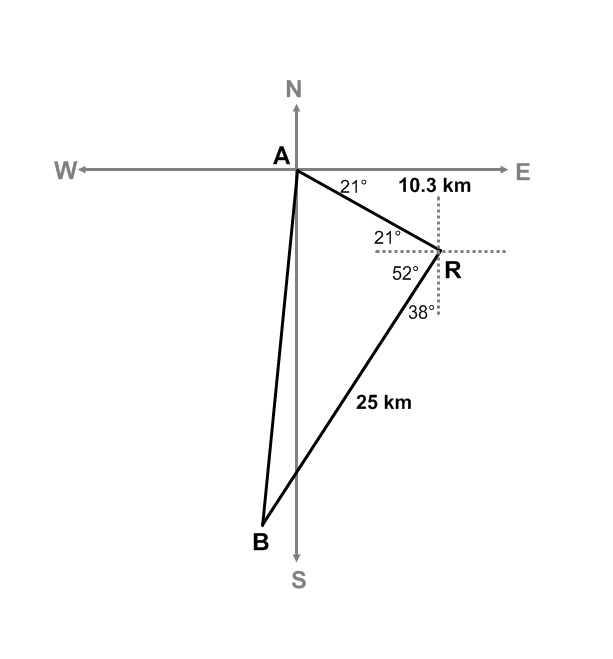
Your diagram should resemble the following:
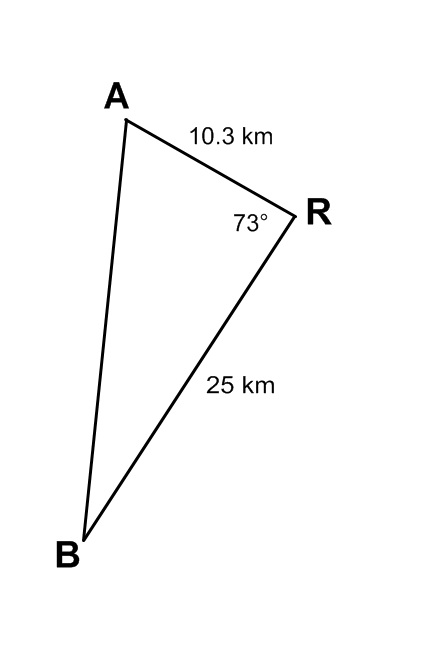
The distance from the starting point to the blue buoy is .
The blue buoy is from the starting point.
- Using the information you gathered on the previous question, determine the angle formed by travelling from the red buoy to the blue buoy and back to the starting point.
The angle formed by travelling from the red buoy to the blue buoy and back to the starting point is .
Therefore, the angle formed by travelling between the red buoy, the blue buoy, and the starting point is .
Extension
Cosine law and solving quadratics
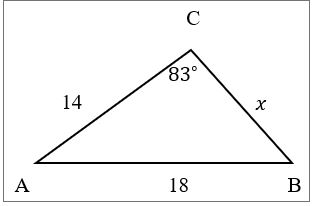
Notebook
Complete each step in your notebook and confirm your answer with the suggested solution.
Set up cosine law for this triangle. Notice that for cosine law, the value on the left of the equation must be opposite to the angle.
Simplify the equation.
We are now left with a quadratic. What are the two ways we can solve for the unknown in a quadratic?
Factoring and quadratic formula.
Refresh yourself on how to use these by reviewing solving by factoring and/or for solving by quadratic formula.
Solve the quadratic.
The unknown side length is .