
In this learning activity, you will learn to solve future value and present value problems involving regular payments or deposits. You will learn to solve problems using a formula, timeline diagram and an annuity calculator. As you have learned previously, future value is the value of an asset or cash at a particular date in future.
Simple vs. compound interest
In the previous learning activity, you learned about simple and compound interest. Based on what you currently know about these types of interest, create a table that shows the similarities and differences between the two.
To solidify your understanding, search for videos that explain key differences between simple and compound interest. Knowing these differences will be critical to your understanding of annuities.

Future value of an annuity
A more common way to invest money is to make deposits regularly.
An investment where a series of equal payments are made at regular intervals of time is called annuity.
Ordinary annuity is the type of annuity in which payments are made at the end of each payment interval.
Simple annuity is an annuity where the payment interval is the same as the interest period. For example, if the payment interval is six months, then compound interest is calculated every six months.
There are various types of annuities, but in this course we only consider the simple ordinary annuity (i.e., where the payment interval matches the compound period and where payments are made at the end of each payment interval.)
The future value of an annuity is the sum of all deposits and the accumulated interest.
The future value of an accumulation annuity is calculated by the following formula, with PMT representing repeating payments.
As you have learned, is the interest rate at which the amount compounds each period and n is the number of periods (or years, not necessarily an integer).
Consider the following situation and its solution. In 1981, interest rates were high. Some accounts earned interest rates that were more than 20%. At that time, Isma opened a savings account that earned 24% interest compounded monthly. Isma deposited $100 into the account at the end of each month. How much money did Isma have in the account at the end of one year? At the end of one year Isma had $1,341.21 in the account.
To calculate the savings, determine the amount of each deposit for the period it earns interest. Use the formula for compound interest, .
The annual interest rate is . Since there are 12 months in a year, divide the rate by 12.
So
Since $100 is deposited each time, then P=$100. The value will change for each deposit. For example, the first deposit will earn interest for 11 months , but the second deposit will earn interest for only 10 months.
Take a moment now to study this timeline diagram. Later in this learning activity you will be asked to make a diagram like this using any tools or technology to which you have access.
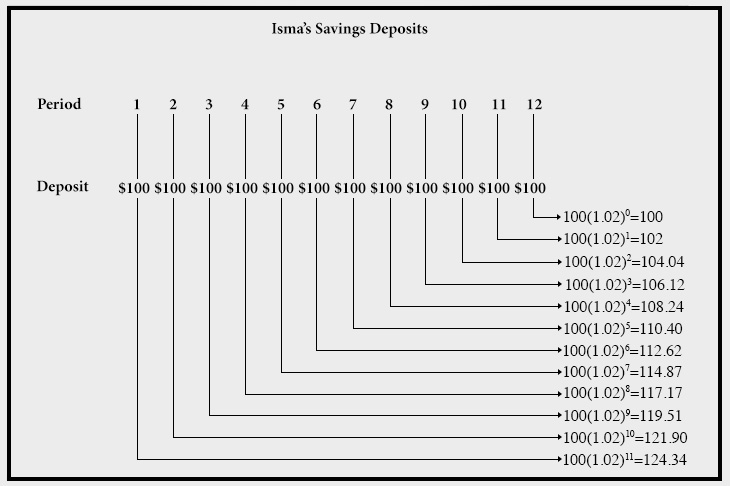
There is a formula that can be used for this purpose, but in this course we will use technology to perform this type of calculation. Before you use the technology to determine the particulars of an annuity, let’s take a brief moment to reflect on Isma’s situation and your own future savings goals.
Try it!

If Isma were to double the deposits to $200, would this double the final amount?
Explain your reasoning.
Using the formula mentioned earlier, if they doubles the monthly deposit, they would have
This is double the amount from the $100 per month annuity.
If Isma’s bank were to double the interest rate, would this double the final amount?
Explain your reasoning.
If the bank doubles the interest rate, he would have
This is not double the amount.
Do you think an annuity is a good way to invest and save money? Why or why not?
It is a good way to invest and save money because you are committed to paying the monthly payment. Sometimes it is hard to put aside money and this guarantees you will put the money aside.
Another benefit of annuities is they usually have better interest rates than regular savings accounts.
Think

If you were going to set up an annuity, what would you be saving your money for?
How much do you need to save?
Set up your annuity
Now that you know how an annuity works, you can use that information to set up your payments and other information. Do some research on the Internet or use another source to find out what present day annuities consist of. For example, what’s the interest rate and term? Is there a minimum monthly deposit?
Based on your research, enter the details into the following annuity calculator or any similar tool to which you have access.
Explore this!

Annuity calculator
Explore the following video that explains how to use the TVM solver on a calculator.
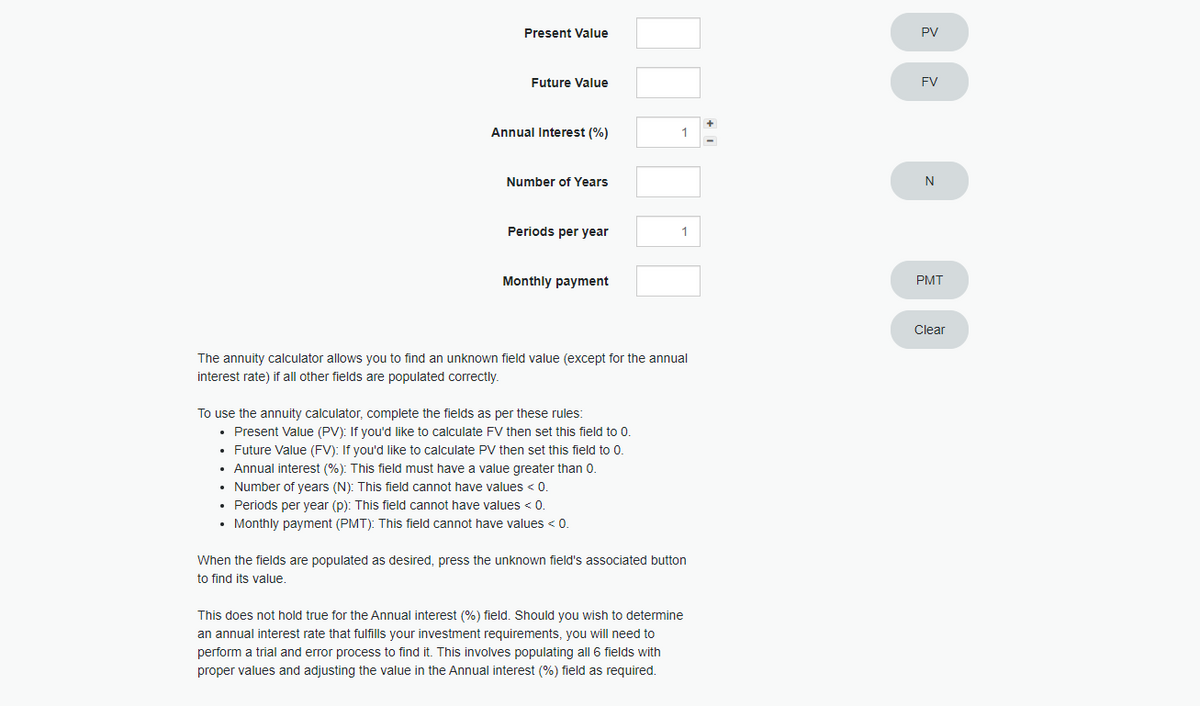
What did you discover? Is your goal attainable? If it’s not attainable, what could you do to achieve it?
If your goal is currently unattainable, you could implement your own monthly budget. It would need to consist of your monthly income, living expenses, discretionary spending, just to name a few.
With some changes in how and what you’re spending your money on each month, a savings goal which currently is unattainable can be often times be attained just by reducing your spending habits by a certain amount of money each month.
Good luck!
Example 1
Isma continued to make $100 monthly deposits into the same savings account for another six years.
Use an annuity calculator to solve the following problems.
How much money did he have in the account at the end of seven years if the rate of interest remained the same?
At the end of seven years, Isma had $21,386.66 in the savings account.
Example 2
Toni deposited $500 in an account at the end of every three months for five and a half years. The account paid 6% compounded quarterly.
Determine the amount in the account on the date of the last deposit.
Toni will have $12,918.79 in their account on the date of the last deposit.
Determine the amount of interest earned in this account.
The interest earned is the difference between the amount and the total value of the deposits made (22 multiplied by $500).
Therefore, the total interest earned is $1,918.79.
Determining the regular deposit for an annuity
In the previous exercises, the payment amount (PMT) of the regular deposits was known. A formula was used to determine the total amount saved at the end of the given period of time. However, there may be situations in which you only know the final value (FV) you would like to save for retirement or for a child’s education.
For instance, you have probably come across advertising that promotes Registered Retirement Savings Plan (RRSP) annuities or Registered Education Savings Plan (RESP) annuities.
Use your favourite internet search engine to learn more about RRSPs and RESPs. Consider using “Sun Life financial” and “retirement savings” as initial search terms to get you started.
The following example shows how the annuity calculator can be used to find what the regular deposits should be in a situation where you are given the total amount that is desired at the end of a known time period.
Example 3
Rick plans to retire in 35 years, and at that time he would like to have saved a half-million dollars ($500,000) in the RRSP, what value of monthly payments should Rick make to reach a goal?.
In this problem, the unknown is the monthly payment (PMT). Determine the monthly deposits they should make into the RRSP if the rate of interest earned is fixed at 5.6% compounded monthly.
Use an annuity calculator to solve the following problem.
Rick should make monthly deposits of $384.59 so that he will have half a million dollars at retirement.
Example 4
How many years would it take for Niall to save $25,000 for the car of the dreams if they deposits $130 each month into an account that pays 7.3% interest compounded monthly?
In this problem, the unknown is . Use an annuity calculator to solve this problem.
It will take Niall 10.64 years, to save enough money for the $25,000 car of their dreams.
Present value of an annuity
The present value of an annuity is the value at the beginning of the term of the annuity.
There is an another kind of annuity called a payout annuity that is more common. These annuities begin with a large balance of money (or large payments) and then the balance decreases with small, regular outflows.
In this section, you will learn how to solve problems related to the present value of this kind of annuity. The present value (P or PV) of an ordinary annuity is the amount of money that must be invested today at a given interest rate, in order to withdraw a series of regular payments. In this situation, the account balance decreases over time.
Calculating present value of an annuity
Abe’s grandparents plan to set up an annuity to help Abe move into an apartment to attend college. Abe will be able to withdraw $3,000 at the end of each year for four years. The first withdrawal will be made one year from now, when Abe begins college. If the annuity pays 7% interest compounded annually, how much should Abe’s grandparents invest now to provide the annuity?
Calculate the present value of each payment. Recall the formula was used to determine the amount of an investment under compound interest. Since you want to find the present value of each payment, you will use the rearranged formula , which can also be written as .
As you know from the exponent lawsthat:
Abe’s annuity is four payments of $3,000. The first payment will be made one year from now. Since the money earns interest, Abe’s grandparents do not have to deposit $3,000 now to have $3,000 a year from now. For each payment, they only need to deposit the present value of $3,000.
The following timeline diagram illustrates the present value of the Abe’s annuity.
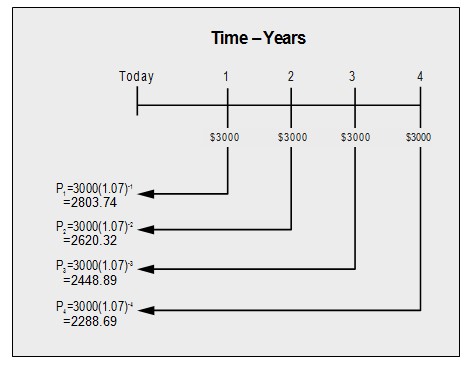
The present value of the annuity, PV, is the sum of the present value of each payment.
Therefore, Abe’s grandparents must deposit $10,161.64 today at 7% compounded annually to provide for Abe’s annuity. Calculating each present value takes time and can be quite tedious for annuities that have more payments over a longer period of time. Once again, using technology is much more efficient.
Think
If the annuity pays 7% interest compounded annually, how much should Abe’s grandparents invest now to provide the annuity?
Abe’s grandparents must deposit $10,161.63 today at 7% compounded annually to provide for the annuity. Notice that this is approximately equal to the sum you found previously. The one-cent difference is just a result of rounding. Therefore, the formula confirms your previous answer.
Calculating loan repayments using pv of an annuity

When a person borrows an amount of money to pay for tuition, a car, or a home, they incur a debt with decreasing balances until the loan is completely repaid.
The amount of money that is required today to repay the loan can be determined using present value.
The next exercise shows how the present value of an annuity can be used for loan repayment.
Example 1
Due to the high cost of college or university education, many students apply to the Ontario Student Assistance Program (OSAP) for a loan to help pay their tuition fees. Students must begin to make payments to repay their loans six months after graduating.
Eva finished college six months ago. The loan payments (PMTL) of $250 are withdrawn at the end of each month from an account that is earning 6.5% interest, compounded monthly.
Try it!
How much must Eva deposit in the account today so that the loan payments can be withdrawn for one year?
Eva must deposit $2,896.99 in the account today, so that the payments can be withdrawn from her account for one year.
What is the amount paid for the loan?
The amount paid for the loan is the number of payments multiplied with the value of each payment.
So $3,000 was paid for the loan.
How much of this amount is earned in interest?
The amount earned in interest is the difference between the payments and the total deposit.
Therefore, $103.01 of the loan was earned from interest.
Using the PV formula to determine payment amounts
Suppose you win a lottery or receive a large sum of money unexpectedly.

To avoid spending all your money at once, you decide to set up an annuity that provides regular payments over a specified time period.
The following exercise explains how the formula for present value can be used to determine the amount of each payment.
Example 1
David inherited $25,000 and set up an annuity that earns 7.5% compounded semi-annually for 10 years, starting six months from now. What will David’s semi-annual payment be? Use an annuity calculator to solve this problem.
The semi-annual payment is $1,799.05.

Some key points:
- An annuity is a series of payments or deposits made at regular intervals of time.
- Formula to calculate future value and present value of annuity is:
Self-check
Rate your level of understanding from 1 (I am still confused) to 5 (I fully understand this concept) based on your results from the questions you just completed.
I am able to:
and , where
is the regular payment.
the interest rate per compounding period.
If there are any criteria where you rated your level of understanding a 3 or below, you should review the concepts before moving on to the next learning activity.
Math journal

At the end of the course, you will fine-tune 8 entries (two from each unit) from your math journal and submit them as your “Culminating assessment - Math journal” (Opens in new window) .
Summarize in your journal what you have learned about future value of annuities and present values of annuities. Your chart may look like this.
| Future value annuity | Present value annuity | |
|---|---|---|
| How to calculate and recognize I,N, FV, PV, PMT | ||
| When to use it | ||
| Type of growth | ||
| Example |
Once you feel comfortable with the success criteria, complete the questions below to assess your progress.
Check your understanding
Now you have the opportunity to check your understanding of solving financial problems that involve the future value and the present value of ordinary annuities.
The Kelly family opened an RESP account for their children and deposit $1,200 every six months, for five years. The plan pays 7.5% interest compounded semi-annually.
Try it!
Using technology, create a timeline diagram that illustrates the value of each semi-annual deposit at the end of five years.
The deposits are semi-annual, so there are two deposits in each year and 10 deposits in five years. The semi-annual rate of interest is .
; ; ; ; ; ; ; ; ;
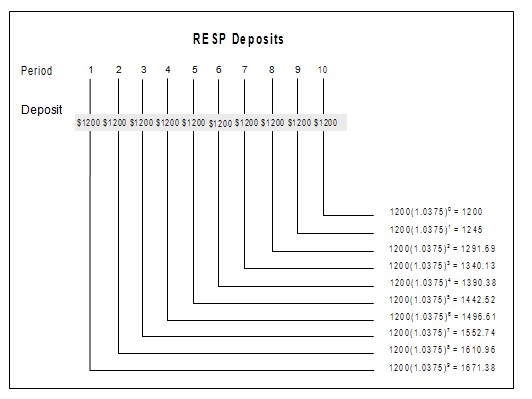
What is the total amount in the account at the end of five years?
Add the amount of each deposit to find the total value of the RESP account at the end of five years.
1,671.38 + 1,610.96 + 1,552.74 + 1,496.61 + 1,442.52 + 1,390.38 + 1,340.13 + 1,291.69 + 1,245 + 1,200
= $14,241.41
How much interest has been earned?
Therefore, the interest earned is $2,241.41.
Use an annuity calculator to solve each of the following questions.
Assessment Opportunity

Journal Entry
To prepare you for the culminating assessment, you have the opportunity to submit a journal entry from this unit to be assessed (no grade will be recorded) for feedback before the final culminating assessment. It will be assessed according to the culminating assessment rubric found below. You may choose to make any updates of suggestions and submit it for the culminating assessment at the end of the course. Make sure to refer to the culminating task requirements for clarification of expectations.
MCF3M Culminating Assessment: Math Journal
You may receive the following forms of feedback:
- Your teacher may highlight the phrases on the rubric that best describe your assignment to show you how you have done.
- Your teacher may also provide you with detailed comments about the strengths of your assignment, the areas of the assignment that need improvement, and the steps you should take before submitting another assignment like this one.
Pay careful attention to the following rubric. Your teacher will use it to assess your work. You should refer to it too, so you’ll know exactly what your finished assignment should appear like.
Success Criteria:
- knowledge of relevant and appropriate skills and procedures
- knowledge of relevant and appropriate facts and terms
- understanding of the meaning of the mathematical content
| Level 4 | Level 3 | Level 2 | Level 1 |
|---|---|---|---|
| With a high degree of effectiveness | With considerable effectiveness | With some effectiveness | With limited effectiveness |
Success Criteria:
- logical interpretation of problem
- evidence of modelling the problem, drawing conclusions, or justifying reasoning
| Level 4 | Level 3 | Level 2 | Level 1 |
|---|---|---|---|
| With a high degree of effectiveness | With considerable effectiveness | With some effectiveness | With limited effectiveness |
Success Criteria:
- math vocabulary used accurately
- math notation and symbols used appropriately
- algebraic solutions, graphs, charts, diagrams organized and clearly written
- mathematical thinking expressed clearly reflection on mathematical thinking expressed clearly
| Level 4 | Level 3 | Level 2 | Level 1 |
|---|---|---|---|
| With a high degree of effectiveness | With considerable effectiveness | With some effectiveness | With limited effectiveness |
Success Criteria:
- relevant and appropriate selection of facts, skills, procedures
- relevant and appropriate connections made between math concepts
- relevant and appropriate connections made between math and the world outside the classroom
| Level 4 | Level 3 | Level 2 | Level 1 |
|---|---|---|---|
| With a high degree of effectiveness | With considerable effectiveness | With some effectiveness | With limited effectiveness |
The teacher will assess your work using the rubric. Before submitting your assessment, review the rubric to ensure that you are meeting the success criteria to the best of your ability.
When you are ready, submit your assessment by pressing the “Submit Your Work” button and follow the submission directions.

(opens in a new window)
You are nearly done with this unit. Keep going with Learning Activity 3.7.